Jump to a section17
Quick guide to basic music theory, written for producers who don’t have time for fluff.
Music theory can feel challenging. I get it, even with basics, I second-guess myself. But it’s learnable. The payoff is real: producers with music theory have more tools, confidence, and discipline. They don’t rely on luck. They create intentionally. That’s the real win.
If you’re not there yet, how do you catch up? How do you write memorable, meaningful compositions? Read on.
The Basics
Start with piano. Every DAW uses a piano roll for MIDI, so learning piano basics makes composition intuitive. Yes, it applies beyond piano, but piano is the foundation.
White Keys
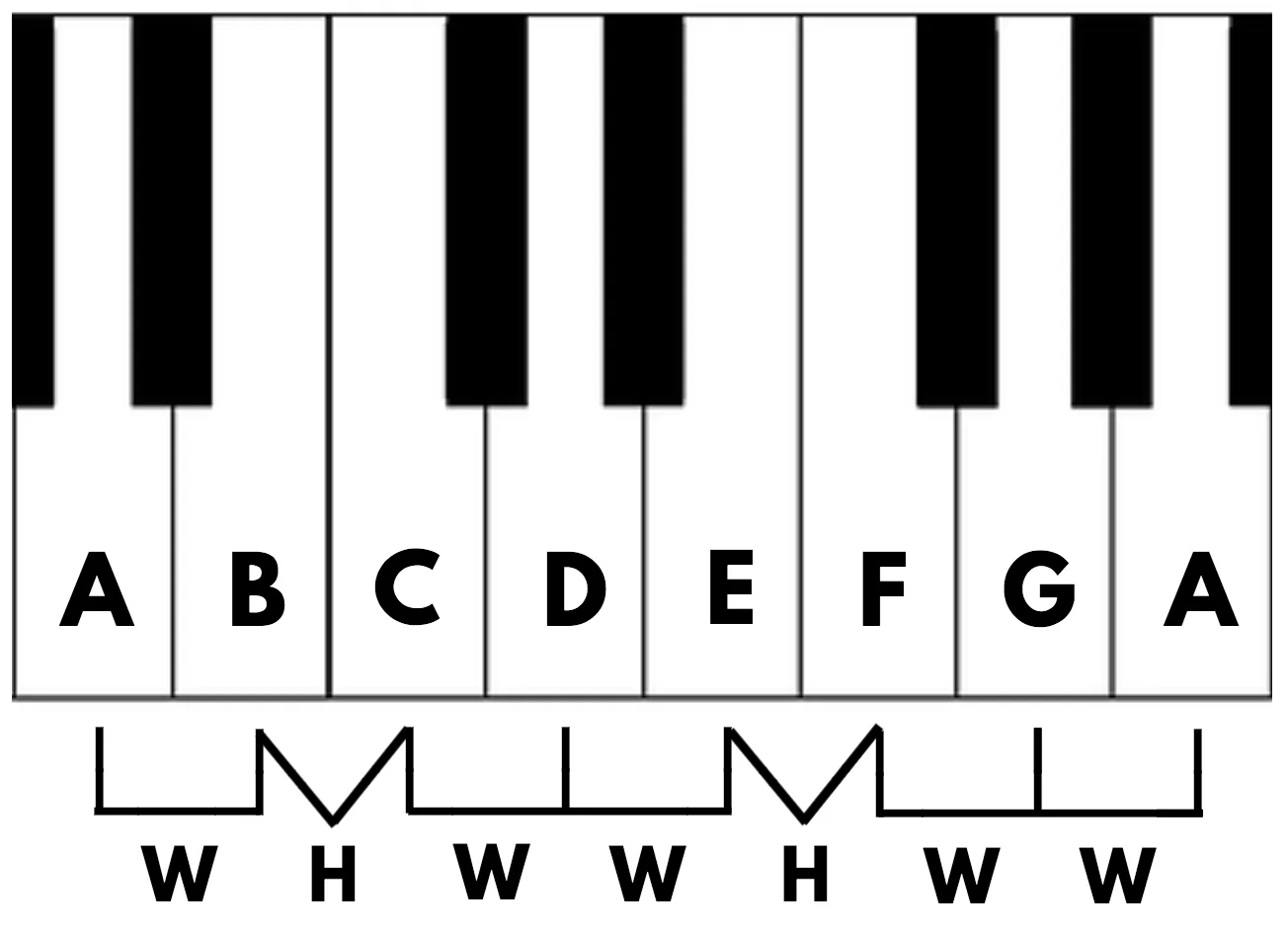
The white keys on your keyboard play the “natural” notes in a scale (C, D, E, F, G, A, B). Playing just on the white keys puts you in either the key of C major or the key of A minor.
Black Keys
The black keys on your keyboard play all the sharp and flat notes (C#, Eb, etc). By incorporating the black keys on your keyboard, you open up the possibility to write in additional keys other than C major and A minor.
Intervals
An interval is the distance between two notes. For our purposes, we’ll be talking about whole-step intervals (a whole step is the equivalent of two semitones) and half-step intervals (a half step is one semitone). Most common musical scales are based on whole and half steps. We will also be defining chords by using whole and half steps, so it’s important you learn this now.
Major Scales
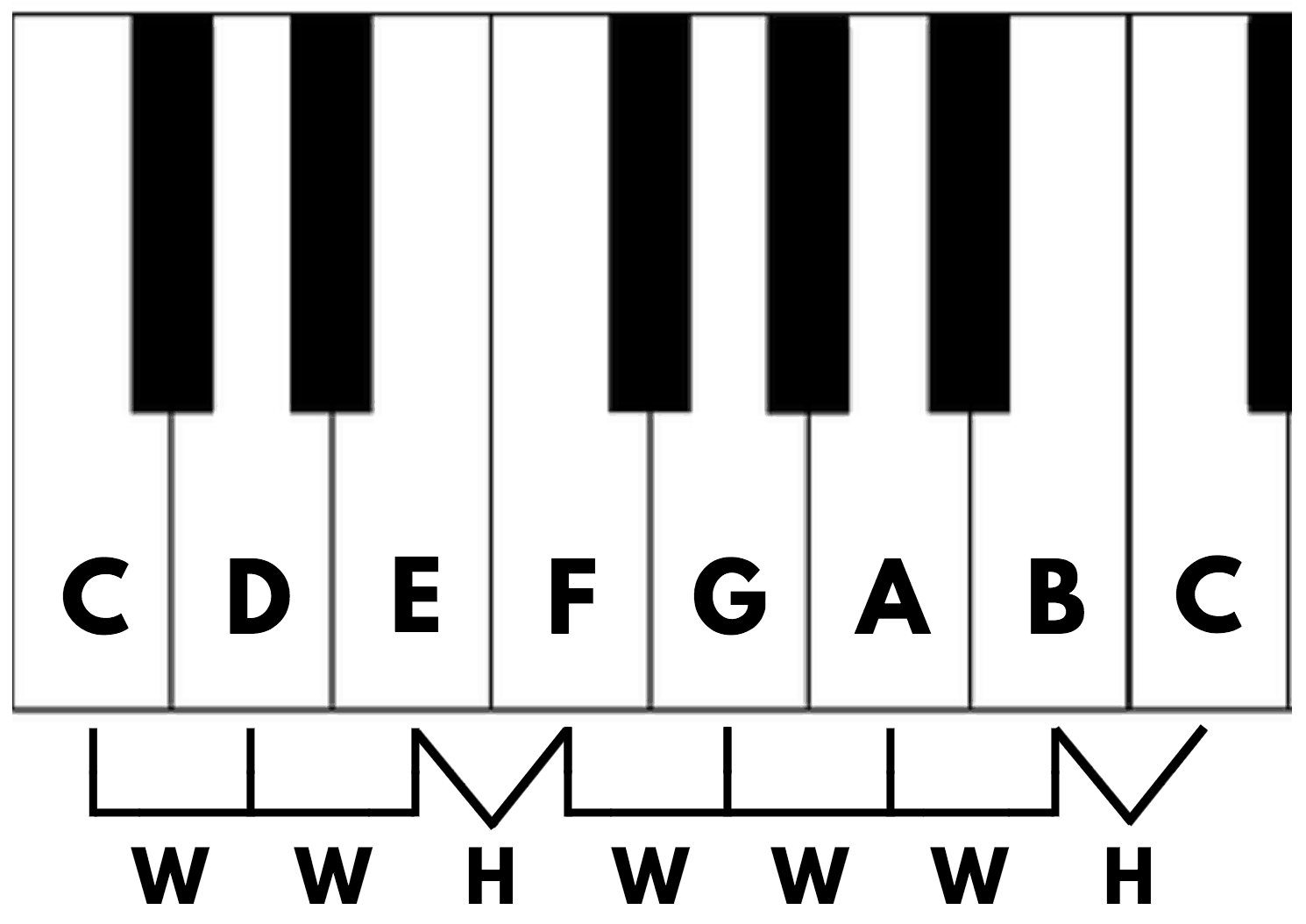
Major scales carry a more light, happy emotional feeling, with most of the emphasis in the key placed on major chords.
Minor Scales
Minor scales can carry a darker, more melancholic feeling, but can also incorporate a more uplifting feeling as well. The majority of current popular music (EDM, pop, rock, etc) is written in a minor key. Minor keys place more emphasis on minor chords.
Chords
Now that you’ve got scales down, let’s talk about chords. A chord is built by stacking notes from a scale at specific intervals. Get these two down first.
Major Chords
A major chord consists of a root note, a second note that is 4 semitones higher than the root note (or 2 whole steps), and a third note that is seven semitones higher than the root note (or 1 and a half step above the second note).
C Major: C-E-G
Minor Chords
A minor chord consists of a root note, a second note that is 3 semitones higher than the root note (or one and a half steps), and a third note that is seven semitones higher than the root note (or two whole steps above the second note).
D Minor: D-F-A
Roman Numeral Analysis
Roman numeral analysis uses Roman numerals to represent chords. The number of the Roman numeral indicates how many intervals the root note of the chord is above the tonic note of the key; additionally, a capital Roman numeral indicates a major chord, and a lower case Roman numeral indicates a minor chord.
Key of C major
V - Fifth note in key is G, and capital indicates a major chord: G Major
Key of A minor
iv - Fourth note in key is D, and lower case indicates a minor chord: D Minor
Pro Tip: When analyzing a chord progression you love, figure out its Roman numerals first. Once you can name a I-IV-V-I or a i-VI-III-VII by ear, you can transpose that progression into any key instantly.
Inversions
An inversion is created by transposing a note within a chord to a different octave. For example, C major (C-E-G) can be inverted so the lowest note in the chord is E, and the highest is C (just up one octave) - E-G-C
7ths & 9ths
7ths and 9ths indicate the addition of the 7th or 9th note above the root note of the chord into the chord itself. For example, Cmaj7 means a C major chord plus the note that is 7 intervals above the rote note (C) of the chord (in this case, the note B). Cmaj7 = C-E-G-B
9ths follow the same rule, but with the addition of the note 9 intervals above the root note of the chord. Different types of ninth chords can also include the 7th, and other notes.
To go deeper on borrowing ideas from other artists, check out our guide on stealing like an artist.
Chord Progressions
Now that you know how to build out major and minor chords, as well as create inversions, 7ths and 9ths, a chord progression is simply how you jump from one chord to another, or a succession of musical chords.
Chord progressions are usually the foundation to most melodic compositions. Even if you start the composition process with something other than a chord progression, you’ll still eventually want to match your melody or hook to a chord progression. There are some styles that might be an exception to this rule, but that is rare.
You cannot copyright a chord progression, so feel free to use existing songs as a form of inspiration or to simply help spark your creativity when writing. For now, let’s get a basic grasp on using chord progressions in your music.
At the end of the day, the important thing to understand about chord progressions is that (at least in Western music) they are relatively straight forward. You don’t need to reinvent the wheel every time you create a chord progression (especially if you are a beginner). Check out Hookpad for an interactive way to explore chord progressions.
Applying roman numeral analysis to chord progressions, here are some extremely popular chord progressions you can try building out on your own:
- I V vi IV - Used in everything from ‘Don’t Stop Believin’ to ‘What’s My Age Again’
- V IV I - Used all over from ‘Sweet Home Alabama’ to ‘Sweet Child of Mine’
- I vi IV V - Think Bieber’s ‘Baby’ or Mariah’s ‘All I Want for Christmas is You’
- ii IV V - Think ‘Smoke on the water’ or ‘Iron Man’
- vi I V ii - Used in ‘Wonderwall’ and ‘Wake me Up When September Ends’
Obviously there is an absurd amount of chord progressions not listed here, but if you are unfamiliar with building out chord progressions, start by re-creating this list so you can familiarize your ears and experiment from there.
Once you’re comfortable with progressions, melodic movement becomes a natural next step. Here’s a breakdown of four ways to build arpeggiated movement on top of your chord progressions.
Arps aren’t just a technique, they’re a way to make chord knowledge feel alive in a production context.
Advanced Harmony
Key Changes
A key change means the usage of a new key for a certain part of a song. This is relatively rare in pop music, but if done correctly can create a strong emotional shift in a composition. Key changes are more common in classical music.
Borrowed Chords
A “borrowed chord” is a chord that typically lies outside of a given key, but is taken from a parallel key. A parallel key uses the same tonic note, but is a different type of scale (for example, C major vs C minor). So, with this example, a chord which exists in the key of C minor but not in the key of C major could be used as a “borrowed chord” in C major.
Pro Tip: The bVII chord (flat seven) is the most common borrowed chord in pop and electronic music. If you’re in C major, try dropping in a Bb major chord. It creates an instant cinematic pull that most listeners recognize immediately.
Secondary Dominance
A Secondary Dominant is the dominant (V7) chord that has the strongest pull to any chord in a scale other than the root. To clarify, in any given key the root is the I chord and the dominant is the V7 chord. In the key of C, the root is C and the dominant is G7.
So, to figure out the secondary dominant of any chord within your scale you can ask yourself what would be the V chord of the scale if the chord I’m choosing were in fact the root.
If you’re writing in C and wanted to figure out the secondary dominant chord for Am (vi in C), all you need to know is that is the V chord in the key of Am. In the key of Am the V chord is E. Make that into a dominant 7 chord and you’ve got yourself the secondary dominant E7.
These are really useful because we know that the V chord has a very strong pull to the I chord. The V7 chord has an even stronger pull to the I. So using the correct secondary dominant chord as a transitionary chord to any chord within your key can have a very dramatic and musical effect.
There are tons of awesome resources online to help you come up with chord progressions, analyze songs you like, and essentially “hack” music composition without a music theory background. But at the end of the day, there is no substitute for a strong understanding of music theory, and putting in the effort will only help you write more compelling compositions.
Music Theory Hacks: Unison MIDI Pack
I used to think every chord progression had to be written from scratch. Then I used tools like Hookpad and didn’t explode. Turns out, using theory tools didn’t hurt my creativity, it expanded it, saved time, and let me try things outside my comfort zone. Made me better at theory, not worse.
This is exactly why, when I learned that one of my former Masterclass students founded a sample pack company called Unison, and had put out a fantastic MIDI Pack, I was pretty damn intrigued.
Once I got my hands on it, I was blown away - I could bypass other midi packs and online services like Hookpad all together, because the pack contains essentially every chord you’d ever want to use. Complete with triads, inversions, extended chords, borrowed chords or even full-on progressions. It’s literally the perfect midi-pack, something I wish I had created for myself years ago to make the composition process significantly easier.
See for yourself below, I recorded a quick, genuine review of the Unison MIDI Pack, and even built out a chord progression and the foundation of a song in under a minute.
Normally, this midi pack sells for $67 - but since you are a Hyperbits reader (or subscriber, student, etc.) you can get 60% off of this pack.
That means that for $27, you can make writing chord progressions an absolute breeze. Whether you consider yourself a beginner at music theory or more advanced at music theory, this pack will dramatically improve your composition workflow, and make things a lot easier for yourself.
And again, as someone who is pretty good at music theory, this pack has actually helped me hone my craft.
This pack isn’t a complete catch up solution if you are struggling with music theory and chord progressions, but it’s pretty damn close.
I’d make the argument that for only $27, this pack is worth more than any music theory course (something like music theory for dummies) you’ll find yourself working through. In the end, I’d do both. Get this pack and brush up on your music theory skills, because the skillset of music theory will only help in the end, and will compliment your creative process perfectly.