Music production myths comes up constantly in producer conversations. Here’s the take.
The majority of production advice you find on the internet sucks.
I get occasional emails from students asking why I “don’t struggle much when it comes to producing music.” Students have mentioned that I “always seem to know what to do” and that I appear to be a very “evolved” music producer.
Here’s the truth: for all intents and purposes, I’m a total fuck up.
My entire life is a set of systems, tools, and accountability structures to prevent me from becoming the worst version of myself.
The version that wants to play video games, order Thai food, and generally be a lazy piece of shit.
The late Anthony Bourdain said it better than I ever could:
“I understand there’s a guy inside me who wants to lay in bed, smoke weed all day, and watch cartoons and old movies. My whole life is a series of stratagems to avoid and outwit that guy.”
If I’m being honest, I’ve ignored some of the most important things I’ve learned because I’ve always felt like a bit of a fraud. Chalk it up to imposter syndrome. Chalk it up to insecurities. Or just modesty.
It doesn’t really matter.
These are things I did as an up-and-coming producer that I can’t honestly recommend as healthy or sustainable. And yet, some of these backward strategies worked. Some of them worked very well.
These are the strategies that helped me work with labels like Universal, Island, Sony, Ultra & Armada, and remix artists like Beyonce, Tove Lo, Nick Jonas, and the Neon Trees.
Here are 7 backward lessons most educators would simply never share.
1. Avoid Trying to Write the Perfect Song
I used to think perfectionism was a good quality. I used to brag about it.
But perfectionism is practically a plague. It means you’re afraid to put anything out unless you’ve meticulously checked and perfected every last bit of your work. Perfectionism translates to fear.
Perfectionists think they need to impose their will so violently and desperately on their creative work that their art simply cannot be good enough without it.
At Hyperbits, we teach quantity over quality. Only by repeating the entire process of creating and finishing music will you ever learn how to get better at the whole thing.
Not half-finished ideas. Not lots of melodies. Not lots of riffs and 8-bar loops.
I’m talking finished, 100% complete songs.
Being forced to finish a song on a schedule makes you realize that every song can’t be treated like life or death. If it was, you’d drive yourself insane.
Do your best on every song. But almost every artist would agree: given the chance to change a few little things about their music after release, they almost always would. Rivers Cuomo of Weezer has stated this in interviews many times.
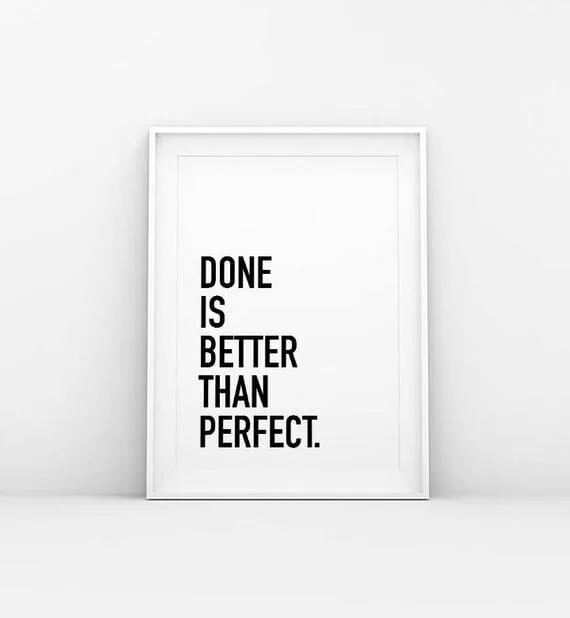
Stop being a perfectionist. Put finishing music before being perfect.
If you want a quick breakdown of how to actually start finishing more music, this one covers exactly that.
Done is better than perfect. Every time.

2. Avoid Hustling
Today’s world is all about doing more. Work harder. Life hacks.
Push yourself. Hustle. Sleep less.
My thoughts? It’s unsustainable.
We all know the artist hustler. The one practically shoving flyers in people’s faces, begging for Instagram followers and remix competition votes. Running around with their head cut off. Burned out, exhausted, fueled by anxiety.
Hustling is a thing of the past.
Artists who swear by hustling let anxiety run the ship. More work does not always breed more success. Hustling turns a marathon into a sprint.
There is nothing wrong with working hard when you pair it with working smart. But I would argue that success needs to come to you.
If no one wants to manage you, if no label reaches out, if no one wants to book you… maybe your music isn’t quite ready for the world yet. And that’s ok.
Downtime is necessary for your ideas to flourish and grow.
Hustling is an ultimately empty, depressing, and destructive lifestyle that promotes reactionary measures over deep thinking and strategy.

3. Avoid Constructive Criticism
When I first started making music, constructive criticism seemed like the holy grail of all the advice I found online.
We’ve all heard it: just get feedback, apply the changes, rinse and repeat.
And to some extent, that’s true. Good-quality feedback can be genuinely helpful.
The problem is, the majority of people offering feedback are just as lost when it comes to their music as everyone else.
So what happened when I started reaching out to everyone I could for feedback?
I got a lot of conflicting advice. Some people said my music had too much going on. Others said it was too simple.
Some said the low end was too thin. Others said it was too bass-heavy. Some flat out told me I wasn’t good enough to make music.
The feedback was inconsistent and not that helpful.
It wasn’t until I narrowed my attention and signed up for a music production school that my music exponentially improved. Why?
I began to collect feedback from 1-2 high-level people. Not 5, not 10, not 20. Just 1 or 2.
Too many cooks leads to chaos.
Other artists agree. Jay Hardaway once shared a story about sending a track called “Electric Elephants” to Martin Garrix for feedback. Long story short, Martin wasn’t into the drop. Jay disregarded the feedback, left it alone, and the song went on to become a major hit.
Half the feedback you get is either wrong or lazy at best. You can’t please everyone.
Instead, seek out 1 or 2 talented producers who can give in-depth feedback consistently. Over time, learn from that feedback to develop your own standards for quality and professionalism.

4. Avoid Marketing Your Music Too Early
A lot of advice online suggests it’s never too early to start releasing music.
But if you’re marketing correctly, that process is time-intensive. That takes away time and energy that could be spent producing and making better quality music.
On top of that, once you do start releasing, every song should out-perform the prior release. There should always be upward momentum.
The Hype Curve
Each release should outperform the last, building upward momentum over time.
If you start releasing before your music is ready, or before you have proper assets and activity across your socials, those releases are wasted.
This is a lesson in opportunity cost. Why allocate so much time and energy into something prematurely?
Holding on to your music until you have a collection of 8-12 songs will allow you to feed your Hype Curve with consistent releases once you do finally start.

5. Avoid or Hide From the World (Occasionally)
Once in a while, it’s totally fine to disconnect.
This idea that you always need to be social, networking, and putting yourself out there can lead to burnout. Not all of us are extroverts. If you’re an artist, you probably lean more towards being an introvert. That’s totally ok.
Extroverts
Regain their energy from being around people.
Introverts
Regain their energy from being alone.
We’re not all created equally.
It’s fine to give in to your desires of being an introvert and quietly keep your head down and get to work on your craft. The moments in life when you are NOT reacting or responding to external stimulus are often the moments your mind grows the most.
Do yourself a favor. Exercise some self love and do whatever it takes to be kind to yourself, even if that means staying home and turning off the world every now and then.

6. Avoid Your Influences
Ok, before you hate on this idea, hear me out (I know this might be the most backward one on the list).
Lil Wayne once admitted in an interview that he only listens to himself when it comes to Hip-Hop. The backlash was extensive. Thousands of fans and haters took to the internet to express their disapproval.
But my takeaway was completely the opposite.
Writing music is an extremely personal endeavor. Just because the majority of artists do things one way doesn’t mean there aren’t alternative paths to success.
Whatever works, works.
Sometimes it’s ok to avoid the artists that got you into all this in the first place. It’s ok to stop listening to new music for a few months. Isolate yourself a bit.
Will only listening to your own music work for everyone? Probably not. But you can’t deny that it works for some.
In an era where everything is recycled, perhaps there’s no better way to find your sound than to stop listening to music altogether for a while. What comes out will be entirely, 100% yours.
That said, I’m a huge fan of using influences to create art. There’s real value in studying what makes great music great. It’s all about balance and intention.
If you’re curious how to draw from your influences without copying them, check out 10 Ways to Steal Like an Artist.

7. Avoid Moderation (In Fact, F*ck Moderation)
Everyone talks about moderation as the key to happiness, to living a balanced life.
Here’s my stance: moderation breeds mediocrity.
Average people love moderation because it’s their excuse to never fully commit to anything. When is the last time you excelled at something you pursued in moderation?
Did Michael Jordan pursue basketball in moderation? Did Porter Robinson pursue electronic music in moderation?
Anything I’ve done that is exceptional in my life has been due to being out of balance for a while. Due to the fact that I was, in fact, NOT living in moderation.
I’m not saying quit your job and abandon your friends. But if you genuinely love making music and want to make a living from it, you owe it to yourself to put your head down and get to work.
Living out of balance is itself a form of balance.
Even athletes operate this way. Pre-season, regular season, post-season, off-season. Periods of intense focus followed by recovery. That off-season allows their bodies and minds to recover after periods of complete disregard for moderation.
Maybe it’s ok to spend 6 months doing nothing other than learning chord progressions and melodies the way the late Avicii reportedly did. Sometimes we must live in complete dedication to the craft.
Greatness waits on the other side.
Be Yourself, Trust Your Gut
We combine an artistic craft with the precision and focus of science. But we all have extremely different ways to achieve similar results.
The core fundamentals (networking, education, collaboration) are worth your attention. But at the same time, being different and standing out is what breeds forward-thinking art and moves culture forward.
So here’s my call to you: don’t fall in line.
Be yourself. Find your sound. Trust your gut.
It will lead you exactly where you need to go.