
Jump to a section11
- 1Pick the Right Competition
- 2Know the Rules, and Don’t Break Them
- 3Do Your Homework, Get Background on the Artist/Label Doing the Competition
- 4Start Early, and Take Your Time
- 5Identify and Use the Hook from the Original Song
- 6But, Put a Twist on the Hook
- 7Engage in the Community, Be Active on Artist/Label Socials
- 8Clean up Your Socials Before Judging Begins
- 9Beg Your Friends to Vote/Engage with Your Entry - But Don’t Buy Votes!
- 10Use Reference Tracks!
- Now Get Remixing
Remix competitions are a polarizing subject. If you can actually manage to stand out, they are insanely useful to your artist career.
Yet if you can’t, remix competitions are an enormous waste of time. Your entry may be lost among the shuffle of thousands of others, and all of that time spent producing is gone.
It can be hard to deny the allure of entering remix competitions after seeing producers like Madeon and Seven Lions launch their careers after winning remix competitions…
Here at Hyperbits HQ, we are BIG believers in the benefits of remix competitions. But there are important considerations when thinking about whether or not to enter a remix competition in the first place:
Why enter a remix competition?
Remix competitions offer a great opportunity for exposure and networking. The remix usually will get the green light to post to Soundcloud and Youtube, which nets you extra exposure from your production. You get access to some well-produced vocals. You can win some free stuff!
Why NOT enter a remix competition?
There are often tons of entries, and you’ll likely get lost among the noise of a thousand producers doing the same remix. Statistically speaking, you have a very low likelihood of winning. Sometimes, posting to Soundcloud and Youtube is restricted, so you can’t even share your hard work once it’s finished.
We all know that great production will help you get noticed. But what else can you do to improve your chances? Everything below focuses on what you can do outside of production quality to stand out.
1. Pick the Right Competition
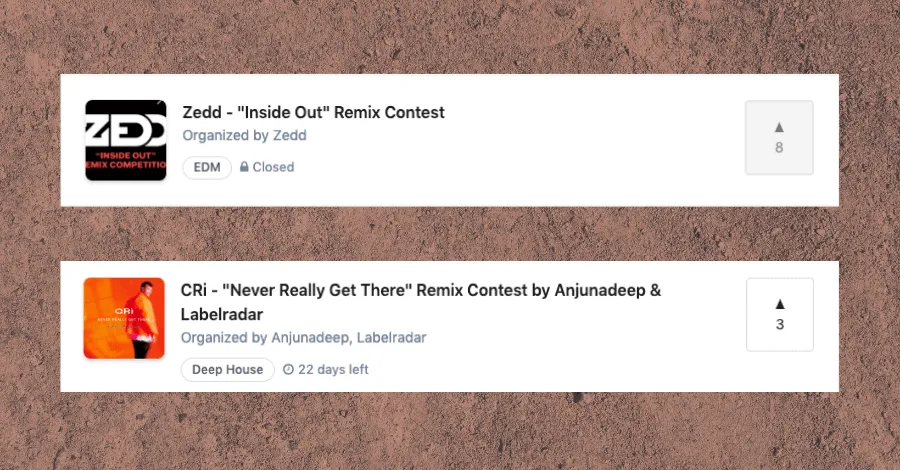
There are tons of remix competitions out there. More artists than ever look to host competitions as a way to gain exposure and connect with producers.
Two primary indicators signal if a competition is right for you: choosing the right genre and avoiding contests that attract massive entry volumes.
First, you probably have your production style nailed down pretty well: maybe you make future bass, dubstep, or techno. Pick a remix competition where your kind of production might possibly win. This doesn’t mean you have to pick a contest where the original song is in your genre, but just know that it will be harder to win a remix competition for a techno label if you only produce dubstep.
Related tool: Start to Finish with Hyperbits: Remix an official major-label release from blank session to master, step-by-step with Serik from Hyperbits.
Second, skip the remix competitions from the HUGE artists. Tiesto did a competition a few years back that got over 5000 entries. Not only is your chance of winning tiny, but the likelihood that you’ll be able to network with Tiesto after winning is slim to none.
Instead, find remix competitions from mid-size artists that might only get a few hundred (or less) submissions, you have a better chance of both winning and networking with them afterward.
Pro Tip: Searching for a competition? Check out Skio and FindRemix. Aim for mid-size artists’ competitions rather than massive ones, you’ll have better odds and networking potential.
2. Know the Rules, and Don’t Break Them
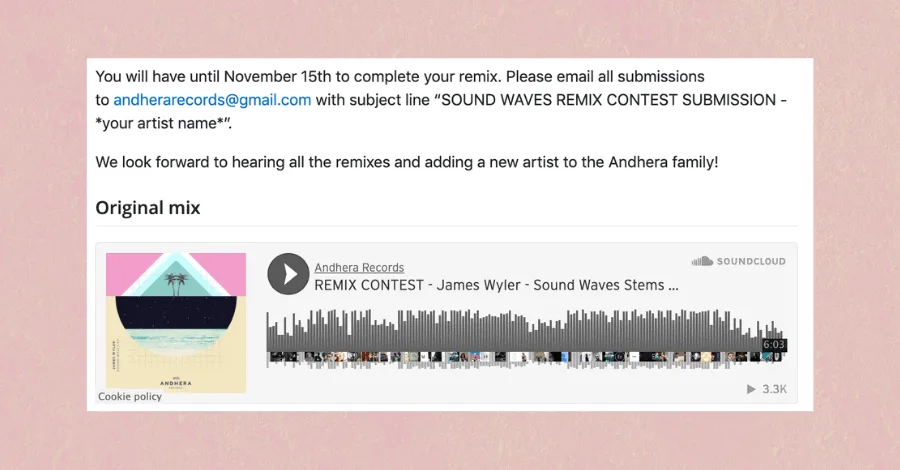
This one is pretty straightforward, but I have to say it, read the rules of the competition, and make sure to follow them! Competitions have strict submission deadlines: sometimes, there are requirements to use specific stems, make the remix a certain length, or follow particular submission guidelines.
Do your homework and follow the rules. You don’t want to get disqualified for something silly!
3. Do Your Homework, Get Background on the Artist/Label Doing the Competition
Don’t compromise your sound just to fit a label’s style. That said, we all produce across a range of vibes, research where your entry fits best.
Study the artist and label: Have they held competitions before? What did winners sound like? What are their recent releases? What music do they play on radio shows or streams? These answers reveal what they’re actually looking for.
Once you have the answers, shift your approach toward that style. If it requires deviating too far from your usual sound, you picked the wrong competition.
4. Start Early, and Take Your Time
Many things in remix competitions are out of your control: the stems, how judges evaluate, or others’ entries. Focus on what you can control.
Time management is critical. Competitions have fast turnarounds, so start early. Don’t rush at the last minute.
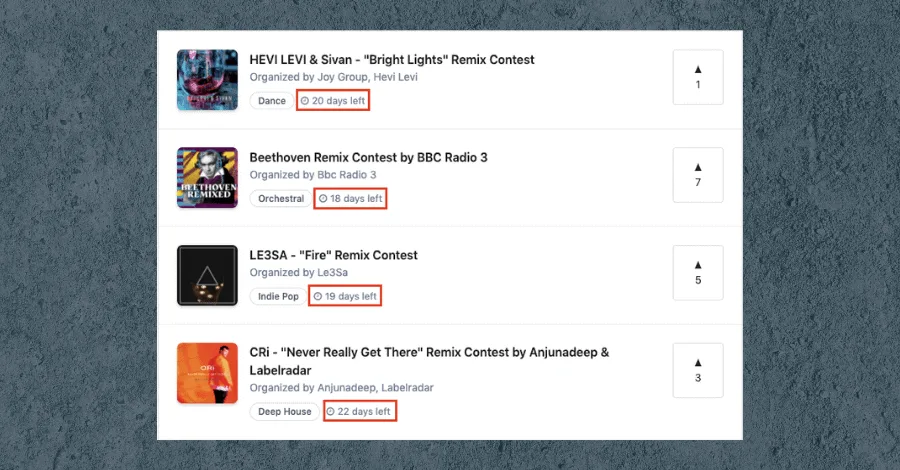
Work on it bit by bit each day. You don’t need to be first, but don’t wait until the deadline. Filter competitions by time remaining to ensure you have enough runway.
5. Identify and Use the Hook from the Original Song
Remixes are about being creative and reimagining the original song from your own perspective. And while we want to lean into that creativity, we need to make sure we do justice to the original.
One method of doing this is by using the hook from the original song. That might be the vocal hook or even a lead melody. Identify the main element, and make sure you use it in your remix. This way, you’ll pay homage to the original, and the hook will serve as a bridge between the original mix and your own.
Example: Above & Beyond - “You’ve Got To Go” (Seven Lions Remix) makes perfect use of the vocal and chords from the original track. Listen to the original mix.
6. But, Put a Twist on the Hook
Now that you’ve got the hook, don’t just drag and drop it into your own project. Put your own spin on it! If it’s a vocal stem, try tweaking the tempo, pitching it up or down, adding extra FX, or chopping it up in some way. If it’s an instrumental sound, rework some of the melodies or adjust the sound design with some extra FX.
Example: Compare Madeon’s remix from earlier to the original mix of Pendulum’s ‘The Island.’ Note how Madeon takes the original vocal hook and adds creative vocoder FX to make it unique and fresh.
Pro Tip: The creative twist is what separates winners from everyone else.
7. Engage in the Community, Be Active on Artist/Label Socials
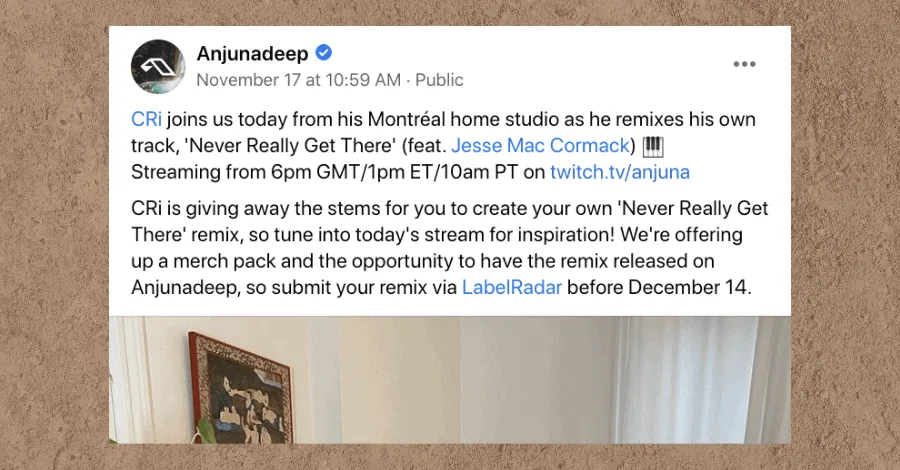
This tip might be our secret sauce to remix competitions…
Real people will be judging the entries, typically, it’s the artist themselves, their management, and some people from the label. You want to make sure that when they play your remix, they recognize your name.
How do you do that? By being active on their social media pages in the weeks leading up to the judging period.
Make it a point to engage with at least one post a day on either the artist’s or the label’s social media. Don’t mention the competition. Just leave a comment or a like on whatever they’re posting. The goal is simple: make sure they say “Oh yeah, I know that name” when they go to listen to your remix.
And remember, make sure you are engaging from an account with your artist name (either your artist page or your personal page if your artist name is your actual name).
8. Clean up Your Socials Before Judging Begins
Remember our talk about managing the things that you do have under your control? This is a simple example of that, clean up your socials before judging begins. Get a good press shot and banner photo, and try to post once a week to Facebook and 2-3 times a week to Instagram.
If the judges like your entry, the next thing they’ll do is go to your social media pages. You don’t need to have a big following by any means, but your pages should look somewhat professional and active. It makes a strong impression on the judges and will look much better than dead, unprofessional looking pages.
Need some inspiration? Zhu has always been the gold standard of social media cleanliness.
Pro Tip: Your profile photo, banner, and bio are the first things judges check. Make them look intentional, even if you only have 200 followers.
9. Beg Your Friends to Vote/Engage with Your Entry - But Don’t Buy Votes!

Many remix competitions have popular vote features, and they matter. Some contests will only listen to entries at the top of the voting charts!
Getting these votes is important, beg your friends to vote for you. Make sure you vote from every email and social media account that you can. You need to be ruthless in your grassroots marketing.
That said, DO NOT BUY VOTES. If ANYTHING looks fishy in your entry, it’ll almost certainly get thrown out. Don’t waste your money and the time you spent making the track by trying to buy yourself a win.
10. Use Reference Tracks!
Ok, I know I said this article wasn’t about production stuff, but I have to throw in just this one: use reference tracks! Especially for a remix competition, these are going to be absolutely critical.
For a deeper look at this technique, check out our complete guide to reference tracks.
The short of it is this:
- Use the original track as a reference track to make sure your gain staging and mixdown measures up.
- Reference other commercially released tracks to gain musical ideas, inspirational sound design, and a roadmap for an effective arrangement.
There is no need to reinvent the wheel with your remix. Use commercially released songs as benchmarks and guidelines to ensure your own production is up to par.
If you want to see referencing in action, this walkthrough covers the exact approach we use.
Once you start referencing consistently, you’ll hear improvements in your mixes almost immediately. It’s one of the simplest habits that separates competitive entries from forgettable ones.
Now Get Remixing
Remix competitions can be a colossal waste of time, but follow these tips to make sure you don’t waste yours! These competitions have helped launch countless artist careers and have made an enormous difference in the growth of tons more. If done the right way, they can make a huge difference for you too.
Learn the methods and approaches used to remix artists as big as Laidback Luke in the Hyperbits Start-to-Finish Course. Learn how to identify the core idea, evolve it into something new, and add your own unique sonic character to your next remix with over five hours of self-paced content.