Jump to a section9
Song arrangement: the practical version every producer eventually needs.
Imagine someone hands you a sunflower, a dozen carnations, and asks you to arrange them into a bouquet. What do you do?
After a few strange looks, you’d probably place the sunflower in the center with the smaller flowers around it to offer support. It’s not the only answer, but it’s the obvious one.
Now imagine someone hands you a dozen assorted flowers, all different shapes and colors, and asks you to do the same thing.
Not as easy, right? That’s arrangement in a nutshell.
Find Your Centerpiece
It can be a bitter pill to swallow, especially since you know the time and energy that went into getting those layered claps just right, but not all sounds in your mix deserve the spotlight. In fact, the spotlight is really only big enough to focus on one or two elements at once. Imagine if every background character tried talking over Tom Cruise. It would be Mission Impossible to make it through without losing your mind.
It’s easier and more effective to make arrangement decisions when you decide in advance which tracks are most important. I can’t stress this enough: a good arrangement is about taking the centerpiece of your song and building a frame around it.
By the end of this article, you’ll know:
- The three types of arrangement, and why you shouldn’t believe the myth that arrangement is just about the order of sections in your song
- Why arrangement in music is important, and how it relates to your number one goal as a producer (which is finishing songs, right?)
- When you should think about arranging a song
- The mindset shift that will turn your loop into an arranged song every time
- The Hyperbits Six Keys to a Better Arrangement
The Biggest Myth About Arranging A Song
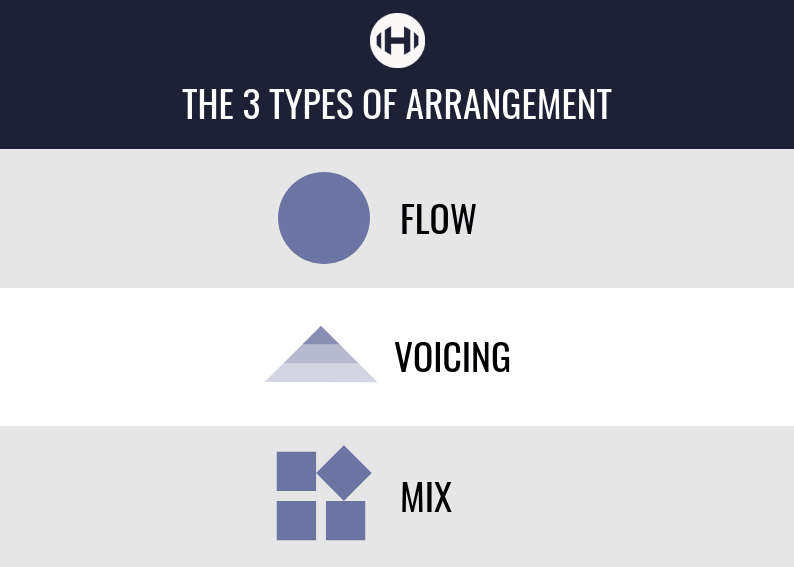
What is arrangement? On one hand, it’s obvious, arrangement is the flow of a song from start to finish. It has sections: intro, verse, buildup, chorus, breakdown, drop, and outro. That’s arrangement of the different movements within your music.
But if you believe that’s all there is to arrangement, you’re missing a whole framework for crafting beautiful compositions. Arrangement is a way of looking at your track from several angles to carve away the excess and support what’s already working. Simply choosing the order of sections doesn’t guarantee a song that captivates your listener’s attention.
There are actually three types of arrangement, and it takes making active decisions about all three to get your track up to par with the music you love.
Structural arrangement is the movement of energy, sections and transitions in your music.
Instrumental arrangement is how the notes, chords, and melodies are laid out across the different instruments in your ensemble. Remember, this can change during the course of your track! Moving the melody line from a vocal to a synth can drive it home in a new and refreshing way.
Spatial arrangement is placing sounds within your mix by determining their volume, panning, and sense of presence.
At the end of the day, arrangement solves for three things: flow, voicing, and mix.
Pro Tip: If you’re arranging and things feel flat, try the “mute game.” Start with all instruments playing, then systematically mute one at a time to see which elements actually matter. Delete anything that doesn’t move the needle.
The Importance of Arrangement in Music
Have you ever had a friend tell you a story they swear is hilarious? It’s built up with details that are totally lost on you, and it’s not until they’re done that you realized you missed the punchline. We all know what comes next: “Ahh, I guess you had to be there.”
Compare that to reliving an inside joke, where even a tone of voice or hand gesture can bring back a flood of memories from some ridiculous situation you experienced together. That’s the difference between a poorly executed idea and a well-polished arrangement.
When I wrote about why dynamics in music are the key to emotional productions, it was to show how many different words within our musical vocabulary all point to this hidden, underlying theme. In a similar fashion, I want you to replace the word “arrangement” with a new word, one that will help you focus on an action.
Bring out your mental dictionaries and pencil this in: Arrangement is all about “Arrival.”
So far we’ve been talking about arranging a song, but I want to be more specific. What makes a song a song is its arrangement. With this article, I want to show you how to arrange an idea INTO a song.
If you’ve been producing music for longer than a day, you know how many decisions need to be made within the process. The best producers out there have built a system of working through these decisions and sticking with them. You don’t want to be thinking about structural arrangement after you’ve recorded the final vocal. And seriously, you don’t need to get bogged down with the details of mix arrangement when you’re developing a chord progression.
When to Arrange
Here’s the Hyperbits Methodology for when you should arrange, based on the three types we’ve identified. Spoiler: it’s not all at once.
Voicing (Instruments)
Determining which instruments carry the melody, chords, and harmony can come first in the process or at the very end. It’s important to know that both options are available, but it’s still a decision you need to make, whether that’s in the conception phase or when the rest of the track is built out.
Some producers like to start with a simple piano patch to build out their chords. Others prefer to take care of sound design first. Got a sweet sounding polysynth? Go ahead and lay some chords down with it. Between the two, I’m in favor of whatever works best for you and your workflow.
That being said, you’ll need to make voicing decisions at some point, and sound design early in the process has its benefits. If you decide to put those chords on an 80’s sounding polysynth instead of a rhodes piano, it will change the direction and vibe of your track. I’m a fan of making decisions and moving quickly, but you’ll need to find what works best for you.
Just remember that the assignment of melody and harmony across instruments is where sound design and arrangement meet, and it’s not to be overlooked.
Flow (Structure)
You should be thinking about arranging for flow once you have a basic idea built out. Maybe that’s an 8-bar loop, a chord progression and melody, or a high energy phrase that would make a great drop. Right now, you don’t have a song. You have an idea, which is seriously exciting. But in order for it to be a song, it needs a different section.
Those that know me will know what’s coming, but it’s so important that it bears mentioning again. And again. In order to create great music, you need to reference. Using tried and true forms is surprisingly liberating. It’s actually a lot easier to create fresh and inventive music within constraints than it is to try to reinvent the wheel every time you’re writing.
Referencing is as simple as dragging a song you admire into your DAW, warping it to match your song’s tempo, and adding flags or markers at the beginning of every new section. You don’t need to adhere perfectly to every bar, but let it be a loose guideline for your song’s structure.
Once you’ve got a structure to work towards, we can easily take this idea and reverse engineer a way to build up to it. There are hundreds, if not thousands of blog posts about ‘getting out of the loop.’ In one way or another, they all are suggesting a variation of exactly what we just suggested.
So don’t overthink this. Drag that reference track directly into your DAW, warp to your BPM, and map out a guide for yourself. There will be plenty (and I mean plenty) of opportunities to stray from this structural map later in the production process.
Pro Tip: Pick a reference track in a similar tempo and genre to your project. Drop it into your DAW, warp it to your BPM, and drop markers at every section change. You’re not copying the song, you’re borrowing its skeleton.
Mix (Space)
Arranging the elements within your track to create a cohesive mix is beyond the scope of this article, but it comes after the flow and voicing is established. In other words, you mix once you’ve finished the song.
If you couldn’t tell already, I absolutely geek out on the art of mixing. I’ve spent years learning what makes a great mix, and it takes time to teach the methodology and technical skills required. If you’re at the point where flow and voicing decisions are starting to come naturally, you’d learn a ton from our Mix Master Flow and Masterclass. If you’re looking for something that follows the journey of a song from composition through the mixdown, our Start to Finish courses would give you a great perspective into how these different types of arrangement all work together.
The Mindset Shift for Turning Loops Into Songs
Here’s a lesson I keep re-learning in my career as a music producer: It’s easier to take away what’s already there than trying to add what isn’t.
Filtering frequencies out of a synth, using reductive EQ, hitting the mute button, these are simple actions, but 9 times out of 10 they’re more effective for creating headroom and space in the mix than boosting or adding new sounds. The same principle applies to arrangement. Reduce, don’t add.
This is a methodology known as Subtractive Arrangement, and it’s been covered by everyone from ill Gates to Dennis DeSantos from Ableton. The loop you’ve built will ultimately be your final chorus. Copy and paste it so you have 3, 4 minutes of material. Keep it at full blast for that last chorus, but for your other sections, mute as many tracks as you can get away with.
Once you’ve got a bare skeleton with a few shared elements, you can add a new instrument if you desire. With that simple move, you’ve backed your way into an A section for the B section you’ve already built. Remember: arrangement is arrival. This is where the fun comes in with transitions, buildups, and creating tension for that full frequency release.
Subtractive Arrangement is a mindset that will let you turn any idea into a song, and it requires working backwards from the idea you have by removing tracks until you have scaffolding on which to hang a buildup.
If you want to see how this mindset connects to finishing music fast, this walkthrough breaks it down in under 2 minutes.
Arrangement is one of the most important skills to cultivate as a producer, because it covers everything from mixdown to how you arrive at the idea that initially inspired you. Here are our six keys for building better arrangements.
Hyperbits Six Keys to a Better Arrangement

-
A good arrangement is one where the song ends a hair too soon. It’s better to err on the side of concluding a second too early instead of running a second too long. Would you rather your listener immediately rewind, or lose their interest by overstaying your welcome? Keep your songs shorter, simpler, and to the point.
-
Reference other music. I’ve said it before, and I’ll say it at least a thousand more times. It will only help. I’m dead serious about this. To reference one of my favorite books, you should Steal Like an Artist.
-
Use varying degrees of dynamics to move between sections. A restrained, reigned in verse will feel more impactful moving to a big chorus than if everything was big and loud from the first bar. And on that note, dynamics are amazing.
-
Take a risk and try something new. You owe it to yourself. Maybe it’s a bold sound design move for a transition, a new way of using a synth or effect. This isn’t just a way to keep your arrangements fresh and interesting, but a way to keep yourself engaged and challenged in the writing process. Our post on overcoming limiting beliefs in music production has a good collision exercise on creative risk-taking.
-
Use repetition to your advantage. Seriously. With enough repetition, anything can become a main melody or motif in a song. It’s one of the most powerful, rudimentary, yet overlooked tools in music production. Repeat a phrase. Repeat it with a subtle variation. Repeat it on a different instrument. These moves will create a call-and-response pull in your music.
-
Include one-time events. On the flip-side, including one-time events is absolutely necessary for maintaining your listener’s interest and creating special, memorable moments within the arrangement. That could be a one-shot vocal chop, beastly drum fill, cascading dub delay. The options are endless. Find something that works for your track, and give it the special attention to detail it deserves.
When it’s all said and done, a good arrangement is one that steps out of the way to let the message in your music shine through.

Chances are it will take multiple iterations to get right, but if you focus on subtracting to make room for what’s really grooving, you won’t go wrong.
It takes practice, and most of all, it takes finishing songs to get in the habit of trusting your instinct and moving quickly. Soon you’ll find that arrangement becomes an inseparable part of your workflow, all the way from the initial idea through the mixdown.