Jump to a section9
Jack Canfield, one of the best-selling authors of all time (he wrote the Chicken Soup for the Soul books), said that he’s read over 10,000 books in his lifetime. But here’s the kicker: he thinks his time would’ve been better spent only reading 1,000 books. But knowing them like the back of his hand.
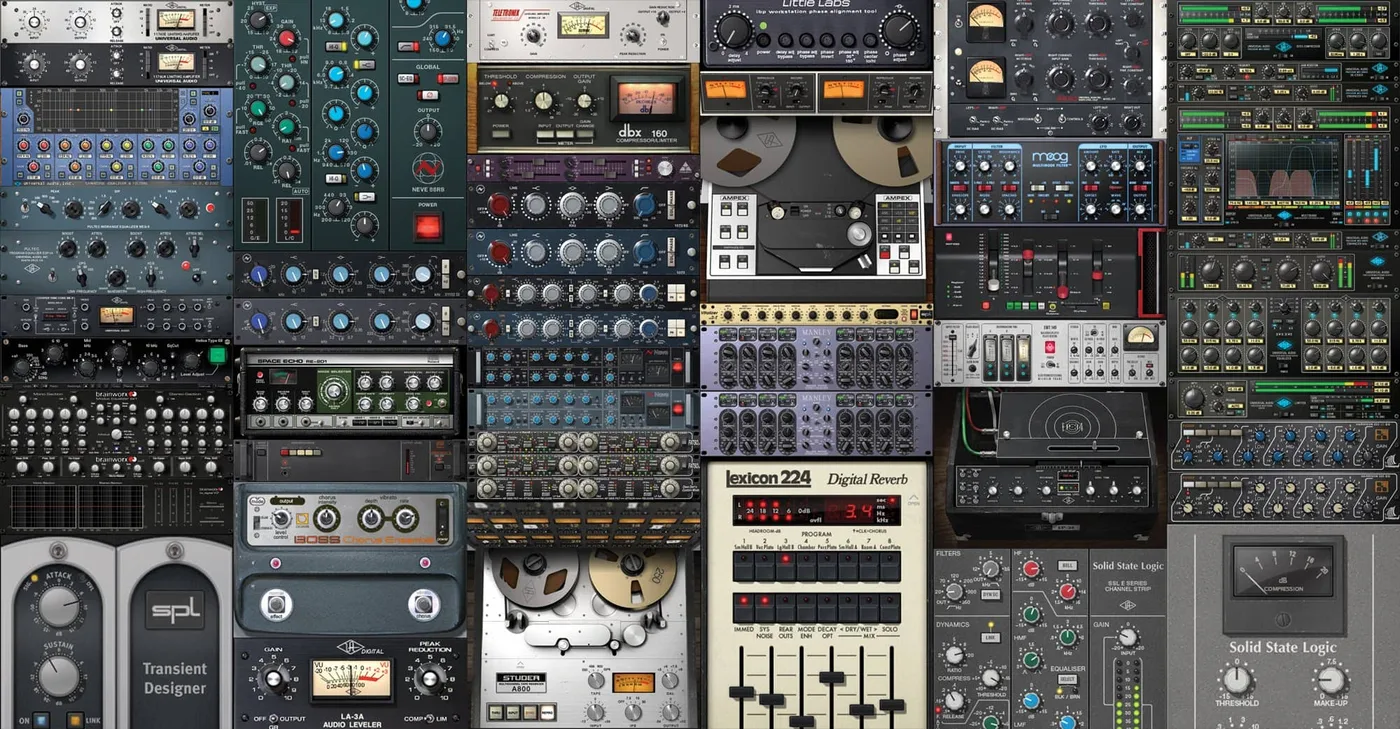
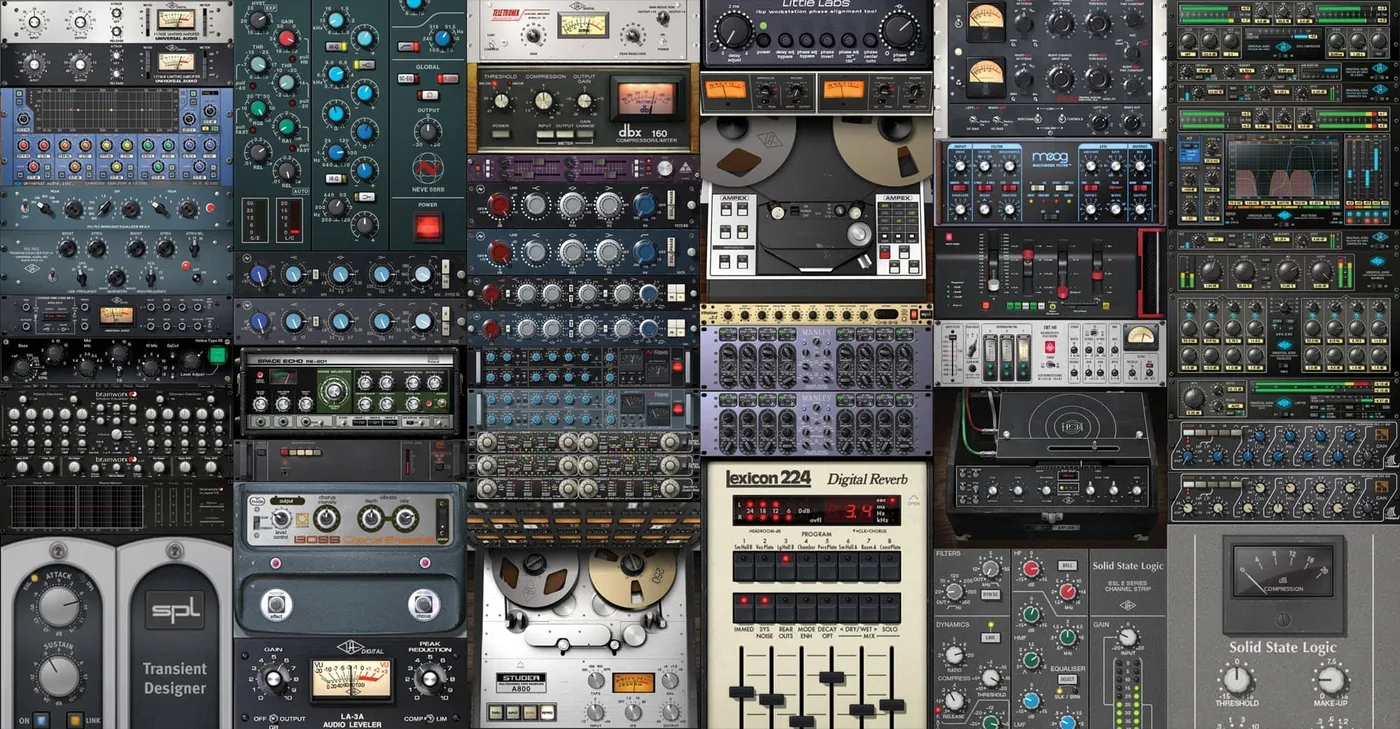
The same is true with plugins in electronic music. It is far better to know a few tools really well, than to collect and stockpile plugins like an episode of TLC’s Hoarders.
And if you think it “doesn’t matter,” you’re ignoring the fact that tons and tons of producers struggle deeply with curating and collecting the right arsenal of plugins on a daily basis.
When is it worth investing in 3rd party stuff? Can you make professional music with JUST your stock DAW’s plugins? When, if at all, should you invest in more expensive or advanced gear like the Universal Audio stuff?
What Plugins Do I Really Need?
No one can actually answer this question because, after all, what plugins you need largely depends on what kind of music you are creating. And because of this ambiguity, anytime a new producer asks “What plugins do I need,” they are usually met with simpleton answers.
But if you look at this question deep enough, it’s actually a great question. After all, what plugins do you really need? How many synths do you really need to produce commercially viable music?
So I did my best to answer the question based on not only my personal experience in music production. But in working with hundreds and hundreds of students and addressing their needs as well.
Some Disclaimers + How to Use This Post
If you’ve ever read any forum about music production, there is always these dismissive assholes who assume they are god’s gift to music production. They’ve taken a few classes, watched a ton of YouTube tutorials. And can’t imagine how anyone could ever possibly break the rules of audio production. Well here’s the thing… Rules are meant to be broken. And the professionals break them every day. They just do it with a sense of purpose and reason.
There’s nothing more wrong than telling you that one plugin is the best for all situations because frankly, in music production that type of ‘one size fits all solution’ doesn’t exist. Instead, as time goes on you’ll find that certain plugins are really good for certain tasks. This guide is merely a way to simplify the vast possibilities of what plugins can be used into a simple set of guidelines to lead to success.
This post isn’t an all-encompassing list of the perfect plugins. It’s more of the approach I’ve seen work time and time again for developing producers.
Organizing the Buckets
Different music, different skill levels, all sorts of differences make this a particularly difficult question, which is why we have to segment this into groups. For this I’ve used 4 of the 5 tiers from Sam Matla’s 5 Stages of an Electronic Music Producer article on EDMProd.
And just to clarify, the lengths below are estimates that I have modified for the purposes of this article. Some producers will move through the tiers faster or slower.
The estimates represent the amount of time generally spent in that specific tier after the previous tier has been completed or defeated (for you gamer’s out there).
- Tier 1 - Initiation (2-6 months): This is the absolute amateur: you’re brand new to production, and still getting comfortable in your DAW of choice.
- Tier 2 - Exponential Learning (12-24 months): This is where the fun really starts. Everything is new and exciting and you’re in a prime state for improvement.
- Tier 3 - The Dip (6-18 months): You’re getting pretty good, but production starts to become very difficult and you’re hyper aware of your shortcomings.
- Tier 4 - Professional/Advanced (2-5 years): You have conquered a genre and invested thousands of hours into music production and can finish tracks regularly.
The Plugin List & Pricing Problem
We broke down the plugins we use into the following groups:
- Things That Make Noise (Synths, Romplers & Samplers)
- Dynamics (Compressors, Sidechains & Limiters)
- EQs (Additive, Subtractive & Mid-side)
- Harmonics (Saturation, Distortion, Excitement)
- Reverb (Rooms, Plates, Halls, & Chambers)
- Effects (Delay, Chorus & Everything Else)
Price & Pricing Problem
Price is a huge factor in what plugins you own. Just because I mention an expensive plugin doesn’t mean you need it, there are plenty of alternatives that do the same thing. Expensive doesn’t always mean better, and a better plugin doesn’t always mean better music. Talent and perseverance beat out gear every time. That said, this guide highlights the plugins I’ve found actually help you get where you want to be.
Tier 1
Initiation
2-6 Months
Tier 1: Initiation (2-6 Months)
Synths/Samplers
In Tier 1, you don’t know much yet, and there are hundreds of synths to choose from. Focus on developing your overall skills, not deep synthesis. Pick one quality synth and get comfortable with it. As you grow, you can add more.
Choose one:
These synths are great at plug-and-play. Plenty of presets and free tutorials will get you decent sounds early on.
The trick: be simplistic. There’s so much to learn about making a full song that spending too much time on synths and sound design will hurt your songwriting and mixing. The presets here are high-quality and will give you a great start.
Mixing Plugins
Don’t invest in third-party mixing plugins yet. You’re learning your DAW, and adding third-party stuff is overwhelming. Stick with your DAW’s native plugins, I still use them constantly. And they’re CPU efficient (important if your computer isn’t cutting edge).
A few exceptions: grab these utility plugins early.
Even advanced producers still use these. I haven’t needed to upgrade them in years:
- Voxengo SPAN, High-quality spectrum analyzer. Helps you understand frequency and pitch from the start.
- Flux Stereo Tool, Amazing stereo imager. Essential for Ableton users (Ableton doesn’t do true panning).
- Oxford Inflator, One-of-a-kind plugin that makes any sound louder and fuller. Worth buying early.
- Xfer Records OTT Compressor, Free tool that adds commercial gloss no other plugin matches.
Other than these four, stick to DAW plugins until Tier 2.
Tier 2
Exponential Learning
12-24 Months
Tier 2: Exponential Learning (12-24 Months)
Synths/Samplers
You’ll want every plugin now, resist that urge. Once comfortable with one synth, it’s tempting to grab the latest shiny ones. Diversifying helps your sound, but too many synths means you’re not mastering any single one.
Pick one and dive deep into the manual. Learn it inside out. Unlike Tier 1, now you move beyond presets and really understand how synths work. Here are my 4 favorites:
These synths are deep. After a decade, I’m still learning new things every day. That’s why they’re worth mastering, no matter how much you know, there’s always something new to discover.
At this stage, you’ll also start using samplers. You’ll realize not all electronic music is purely electronic. You’ll play with organic sounds and sample-based libraries.
Native Instruments Kontakt is the essential sampler. It lets anyone turn recorded content into synths. Thousands of libraries exist, all dramatically different.
For Tier 2, get quality organic sounds: piano, brass, strings, and maybe a unique vocal library. My favorites:
- Alicia’s Keys Piano
- Symphony Essentials
- Session Strings Pro
- Output Exhale
(This is just from my own experience. Kontakt has too many options to cover. This guide is a starting point, not exhaustive.)
Mixing Plugins
In Tier 2, you start caring about mixing. Your music doesn’t sound commercial yet. Time to invest in quality third-party mixing plugins.
Dynamics (Compressors, Limiters)
You understand compression basics but are still unsure when to use it. You know the terms and you throw compressors on things. You get that a mastering chain needs a limiter for commercial volume. You’re learning. Here are our favorite Tier 2 dynamics tools:
EQs
You understand EQ now. You use high-pass, low-pass, and bell curves to remove unwanted frequencies. Your stock EQ mostly works, but a third-party one gives you variation:
- Built-in EQ
- Waves Q (1-10)
Saturation/Distortion
You’re discovering saturation as a warmth tool. Find a couple nice saturators:
- Softube Saturation Knob
- Fielding DSP Reviver
Reverb
Valhalla makes superb, affordable reverb. These are so good you’ll use them forever:
Effects
You’re hearing delay and pumping effects on cool tracks. Figure out what you like:
- Nicky Romero Kickstart
- Waves H-Delay
- SugarBytes WOW
Tier 3
The Dip
6-18 Months
Tier 3: The Dip (6-18 Months)
Synths/Samplers
Like Tier 2, keep learning your favorite synths inside and out. But now broaden your palette. You’re ready for more variety.
You could pick 1-2 new synths and learn them deeply, like Tier 2. At this point, your limit isn’t the synth, it’s how well you know it. If you can make any sound with one synth, why spend time learning new ones? Most synths work similarly anyway. Synthesis is limited more by understanding than by the tool itself.
Only move to new synths when you know Tier 2 synths like the back of your hand. Worth exploring:
- Native Instruments (Absynth, FM8, Reaktor, Monark)
- Sonic Academy A.N.A
- Spectrasonics (Omnisphere, Trilian)
- Synapse DUNE 2
- U-he (ACE, Diva)
For sample libraries, you need variety. Different samples can’t be created from the same library. You’ll need to experiment. It’s overwhelming but worth it. Additional Kontakt libraries:
- Session Guitarist
- Abbey Road Collection
- Studio Drummer
- Scarbee Collection
- Session Horns Pro
- Action Strikes
Mixing Plugins
Dynamics (Compressors, Limiters)
Now you realize compressors all sound different, each adds its own coloration. You care about which compressor you use and how to glue synths together. You understand when to use compression. Limiters matter when competing with professionals:
- Waves SSL Collection Compressors and API Collection
- DAW native multiband and Xfer OTT
- AOM Invisible Limiter
EQs
This is where EQ gets serious. Balanced mixes demand understanding reductive vs additive, digital vs analog. All EQs aren’t equal. FabFilter Pro-Q is the best:
- FabFilter Pro-Q
- Waves PuigTec EQP1A and SSLEQ
Saturation/Distortion
Saturation and distortion become essential. You can mangle simple sounds into heavy, thick tones. You saturate almost everything to fatten tracks without needing heavy mastering limiting:
- SoundToys Decapitator
- iZotope Trash 2
Reverb
Still using Valhalla Vintage Verb? Time to explore room, plate, chamber, spring. Valhalla’s affordable and great, stay in the family:
- Valhalla Room
- Valhalla Plate
Effects
Effects drive your music now. You use them for transitions, movement, texture, modulation. Invest in SoundToys bundle (Decapitator is the crown jewel, but they have fantastic effects I use everywhere):
- SoundToys EchoBoy
- SoundToys Crystallizer
- Xfer Records LFOTool
Tier 4
Professional / Advanced
2-5 Years
Tier 4: Professional/Advanced (2-5 Years)
Synths/Samplers
You’ve made it. Your understanding of your main synths is extensive. You’ve “mastered” the genres you produce.
Now it’s about finding the sounds you want, not learning new tools. It won’t intimidate you to pick up a new synth or library. Every professional has different tools at this stage.
After learning Tiers 1-3 deeply, start finding unique solutions that fit your style and genre. Here’s my current toolkit (used on almost every song):
- Xfer Serum
- Kontakt Libraries (Output Exhale, Output Analog Strings, Output Substance, London Contemporary Orchestra Strings via Spitfire, Alicia’s Keys)
- Spectrasonics Omnisphere
- U-he Diva
That’s it. Pretty simple.
I spent years mastering Serum so I don’t need other digital synths. I’ve built a sample library matching my taste. I’ve learned a few more synths for creative flexibility.
It doesn’t have to be complicated. You don’t need to know everything.
Mixing Plugins
Dynamics (Compressors, Limiters)
You know compression inside out. Every parameter is a tool. Now venture into hardware plugins requiring DSP. You probably have an Apollo interface and UAD plugins. Many great compressors exist, but a few are unbeatable:
- Universal Audio Compressors (UA 1176 & Teletronix LA-2A)
- FabFilter Pro-C
- Hardware Compressors
- FabFilter Pro-MB
- FabFilter Pro-L
EQs
EQ is now a strength. You have EQs for additive and reductive, with great ear training to spot frequency gaps. You hear the subtle differences between EQs and pick accordingly. FabFilter Pro-Q is still the best digital EQ, but now use analog emulated EQs for subtle boosts/cuts:
- Universal Audio EQs (Pultec EQP-1A & Pultec MEQ-5)
- Hardware EQs
Saturation/Distortion
You’ve mastered saturation tonally and now use unique distortion for special characteristics. Get into tape emulation and excitement. Use EQ and compression as saturation tools too. Favorites:
- Soundspot Halcyon
- Universal Audio Tape Emulations (Ampex ATR-102)
Reverb
Still happy with Valhalla, but ready for more options. Analog reverb appeals to you, but not the thousands-of-dollars cost. UAD emulators are fantastic:
- Universal Audio Reverb (RealVerb-Pro & DreamVerb)
- Valhalla Shimmer
Effects
You use effects on everything now. Get the best. Complete SoundToys bundle is essential. UAD effects are also serious, so close to hardware you wonder why anyone buys hardware:
- SoundToys Complete Bundle (Tremolator, Little Alter Boy, Filter Freak, MicroShift)
- Universal Audio Effects (Precision Delay Mod, ADA STD-1 Tapped Delay, EMT 250)
Know Your Tools, Then Grow Your Collection
This isn’t the ultimate solution to all your production problems. It’s the approach that has worked for us, and for hundreds of students, at each level of development.
Start simple, go deep, and expand only when you’ve actually outgrown what you have.
The plugins listed in each tier aren’t the only options. They’re the ones that have consistently worked for us and for our students. Use them as a starting point, then build your own toolkit based on your genre, your workflow. And what actually helps you finish music.
Heads up: some of the links below are affiliate links. If you buy through one, we earn a small cut (costs you nothing extra). But we'd point you at this exact gear whether we made a dime or not.