Jump to a section12
- Why Bass is So Important in Electronic Music
- How to Write Bass Lines: Melodies
- Indirect Extension: Playing Notes Not in Your Chord (But Still in Key)
- Combining the Approaches
- Picking the Right Octave
- How to Write Bass Lines: Rhythm
- Not Branching Off
- Somewhat Branching Off
- Reeeeally Branching Off
- How to Write Bass Lines: Main Takeaways
- How to Produce Bass Lines
- Now Get Back to Your DAW and Make It Groove
There is something about writing bass lines when producing electronic music that just feels right. When you write a great bass line, you start bouncing in your chair, bobbing your head, and the whole groove of a track almost magically appears out of thin air.
Plus, I know you have made the :O face when a gorgeous, groovy bass line drops on the dance floor at a club or festival.
Writing bass lines is tricky. The best ones are simple, yet tasteful and intricate. They create a familiar foundation that guides listeners through the song. You might not know where it’s heading, but a great bass line will have your head bobbing and feet moving.
This is the ultimate guide to writing bass lines in electronic music. Two main goals here:
First, I want you to understand why bass lines are so important in electronic music and how a bass line should fit into the song as a whole. Second, I want you to walk away with a bigger toolbox of tips and tricks for writing bass lines, knowing how to approach them from both a melodic and rhythmic perspective. Sound good? Let’s get started.
Why Bass is So Important in Electronic Music
At its core, electronic music is made for live events. It’s music that is meant to be played on big sound systems for dance floors full of sweaty ravers. This means two things if you want your song to sound great: it better have a fat low end, and it better have the funk. You can accomplish both of these things with a lush, groovy bass line. You need a bass line that not only is cool on its own and is meaty and heavy, but also one that compliments the rest of your song.
How to Write Bass Lines: Melodies
Chances are, you’ve started a track idea and you have some sort of lead melody or chords already sketched out. I want you to begin by thinking of your bass line as an extension of those other elements. Now, how direct of an extension of those other elements? Your answer to that question will determine how you choose the melody of the bass line.
Direct Extension: Play the Root Note of Your Chords
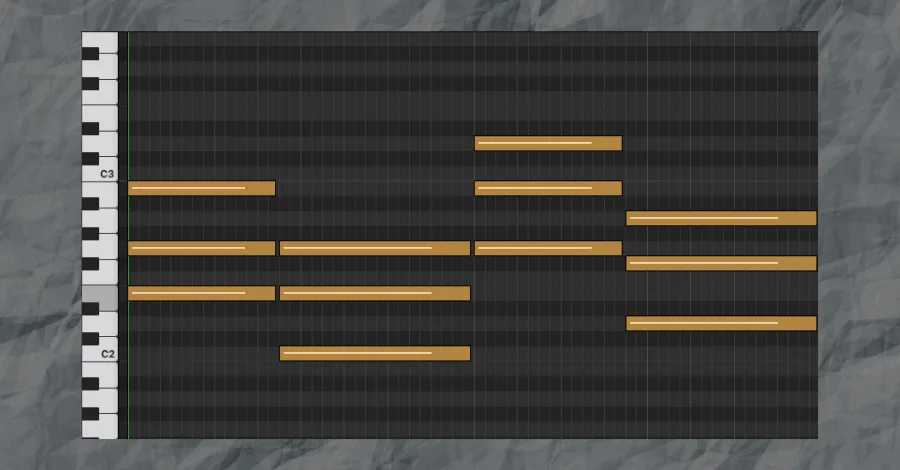
If you want your bass line to match seamlessly with the chords you’ve already created, simply take the root note of each chord as the melody for your bass line.
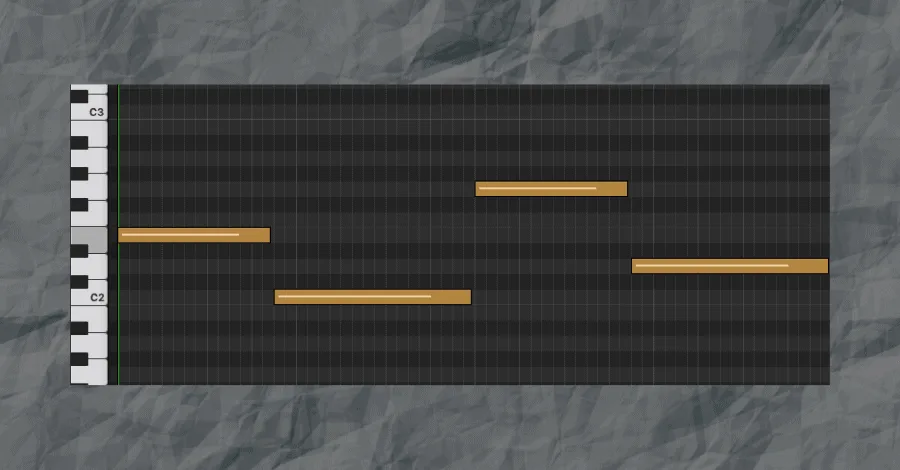
For example, if your chord progression is E minor, C major, G major, D major, your bass line notes become E, C, G, D. Simple as that.
The upside to this approach is that it will “work” in nearly every scenario, since you’re playing notes that already exist in the song, plus they’re probably the most important notes already in your chords. The downside is that only playing these notes can get a little boring, because they are a bit simple in the end.
Mostly Direct Extension: Part 1, Play Notes in Your Chord That Aren’t the Root Note
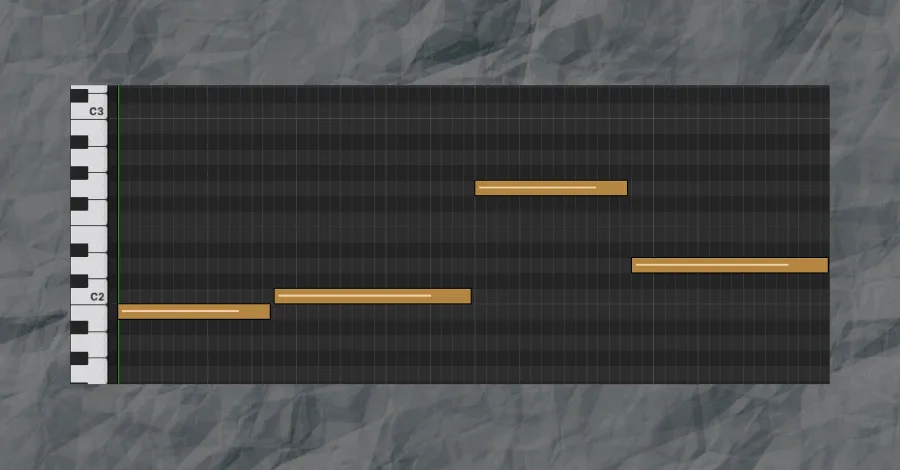
Back to our E minor, C major, G major, D major chord progression. The chord of E minor has three notes: E, G, and B. Any of these notes are fair game for the first note of your bass line.
So, instead of the first two notes of the bass line being E then C, try B then C, which will create a TOTALLY different feel to the progression. I recommend mixing and matching between root notes and other notes to create a familiar and simple, yet unexpected and interesting bass progression.
Mostly Direct Extension: Part 2, Playing Multiple Notes Within Your Chord
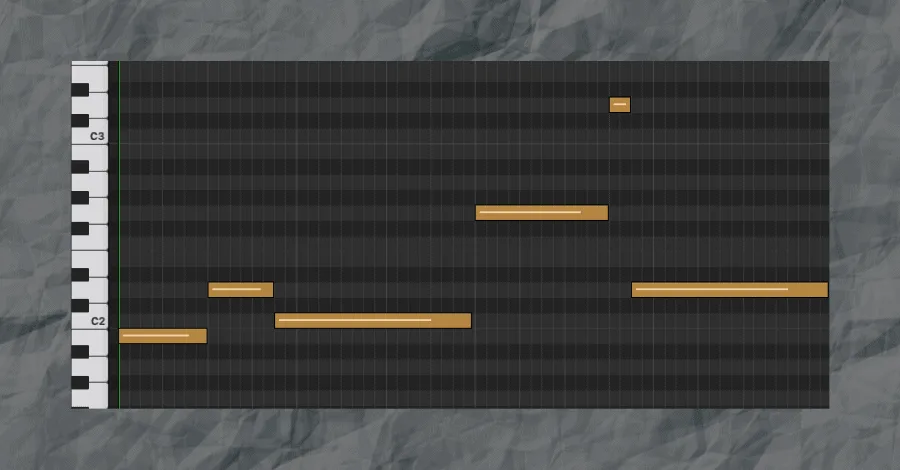
To be clear, I do not recommend playing multiple bass notes at once. This gets real ugly, real fast.
But, if you have a 1 bar E minor chord, you can play the first two beats of your bass at B, and the second two beats at E (or vice versa). This is another way to add controlled variation beyond just playing the root note of a chord.
Indirect Extension: Playing Notes Not in Your Chord (But Still in Key)
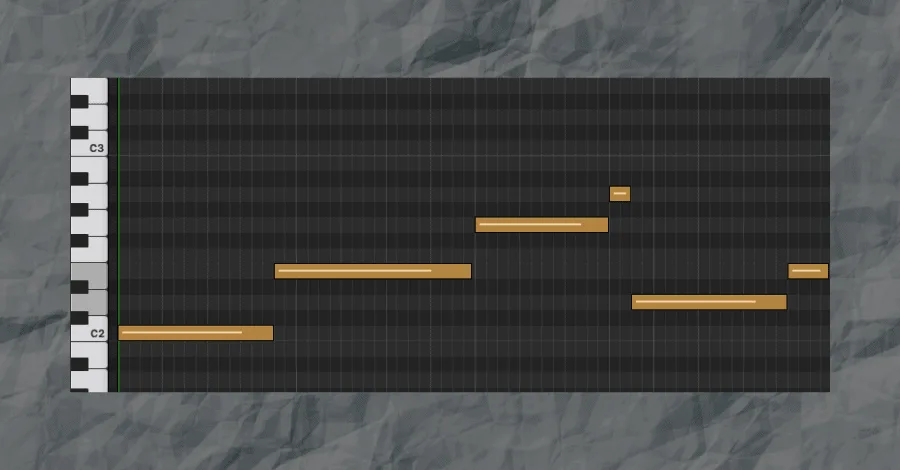
Take the first two chords in our progression. E minor has three notes, E, G, and B, and C major has three notes, C, E, and G. E and G overlap in both, but B and C are unique.
You aren’t restricted to only using B and C as your bass notes during the times when the chords which contain them are also playing. In fact, playing these unique notes outside of their chord can sound awesome as well.
Now, some of these combinations will sound great, but others won’t. I recommend simple trial and error and trusting your ears with what sounds good. For instance, I think playing C as the bass note for the E minor chord works great, but playing B as the bass note for the C major chord doesn’t.
Pro Tip: When trying indirect extensions, start by borrowing from the chord directly before or after the one you’re playing under. Those neighboring notes tend to have the strongest harmonic pull and will resolve more naturally than random in-key notes.
Combining the Approaches
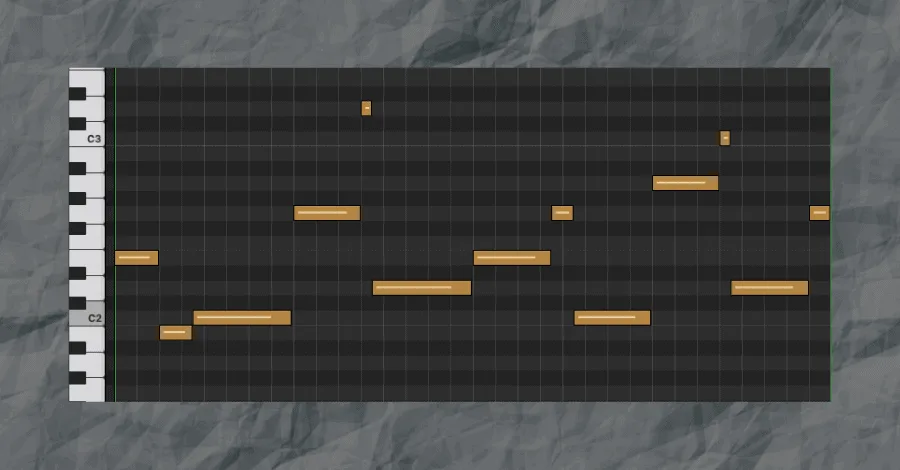
I alluded to it before, but your best bet is usually to combine some of the Direct, Mostly Direct, and Indirect Extensions. I recommend starting with the bass line playing the root note of your chords (Direct Extension), and modifying from there. If you have a four chord progression, try having two bass notes play the root of your chords, and two play other notes from other chords.
Finally, there is no limit to how many bass notes you can play through the duration of a single chord. I mentioned two above, but you can experiment with as many as you’d like. I love having a new bass note come in on the final beat of my chord to act as a “transition note” to the next chord and bass note.
Picking the Right Octave
Ok, so now you’ve picked your bass notes using a combination of different extensions. Now, what octave should you put them in?
As with anything in music production, there is no hard and fast rule on this. In general, I recommend avoiding notes below E1. This corresponds to roughly 40Hz, which is where a lot of headphones and speaker systems start to lose their low end. This means that if you put a note below E1, the listener might not be able to hear most of it.
If you need to hit a D or a C, just bump it up an octave to D2 or C2. Transposing a bass note an octave won’t really affect the “feel” or mood of the track, and keeping your bass notes somewhere between E1 to G2 (again, this is just an approximation) will allow you to take full advantage of the sub frequency range in your track.
As an example, take our original Direct Extension bass progression: E, C, G, D. These notes positioned at E2, C2, G1, and D2 would sound fantastic (and feel fantastic on the dance floor). But remember, this will depend on which octaves your oscillators are tuned to, so be sure to also check what frequencies you are hitting with an EQ or spectrum analyzer.
Pro Tip: Use a spectrum analyzer while writing bass lines, not just while mixing. Seeing where your notes land in the frequency spectrum early on saves you from painful fixing later.
How to Write Bass Lines: Rhythm
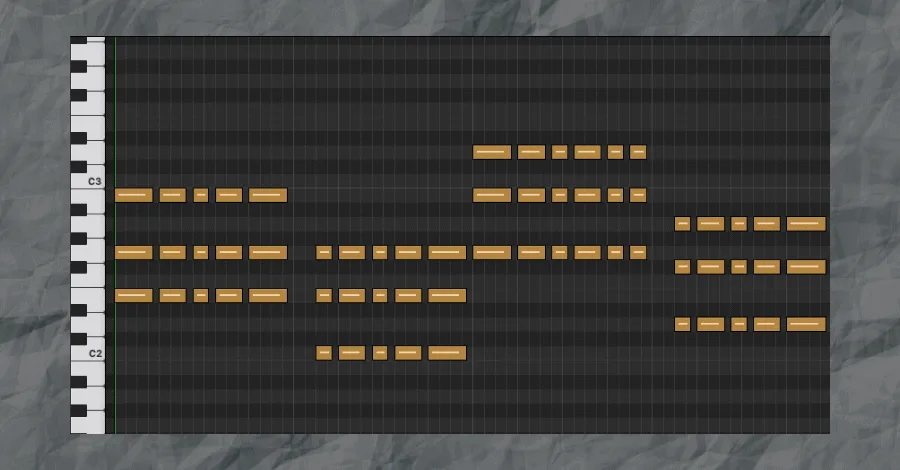
Now, this is where the funk starts to come in.
Let’s think of the lead and chords as our starting point again. For composing the rhythm of a bass line, there are three variations of how far away we can branch off from the rhythm of the lead and chords: not branching off (sustained bass notes), somewhat branching off (using the rhythm of the lead or chords), or reeeeally branching off (introducing a new rhythm).
Not Branching Off
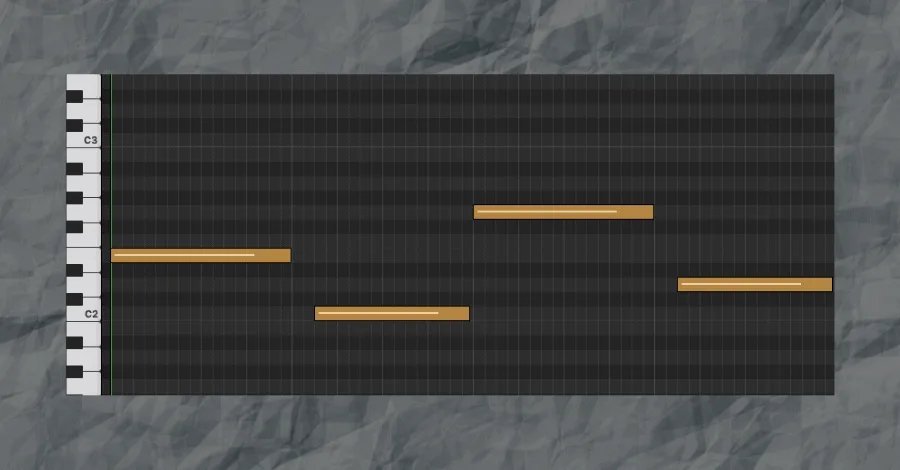
This approach is pretty straightforward. If you have a 1 bar sustained chord, you play a one bar sustained bass note. The upside to this approach is that your bass basically becomes a layer in your chord, adding weight, beefiness, and size to the chords. In some cases, this is exactly what you want.
But, you lose the opportunity to add extra groove to the track when you just play sustained notes with your bass. So, ask yourself what you want to accomplish with the bass, and go from there. If your answer is to make a chord stack bigger, this is your approach; if it’s something else, continue below…
Somewhat Branching Off
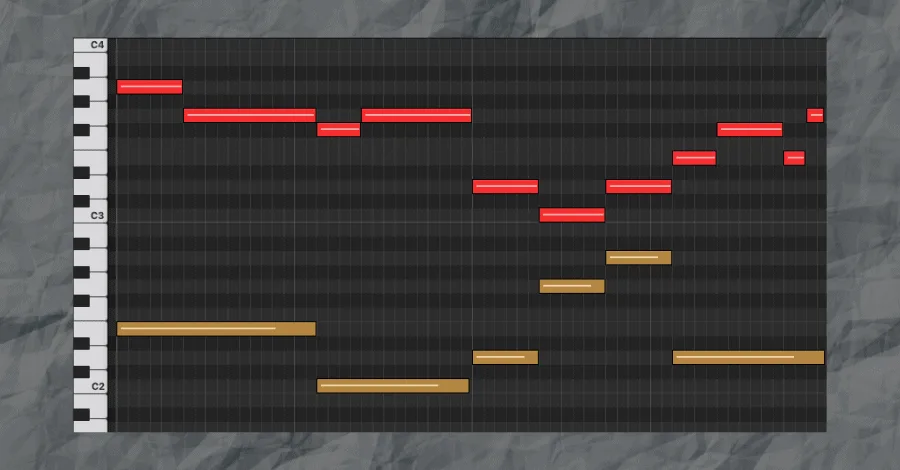
If you have a lead melody, have the rhythm of your bass notes follow some (or all) of the rhythm of the lead notes. This is a happy middle ground between adding size and depth to the lead and chords while still adding extra groove to the track as a whole.
When you do this, I recommend experimenting with different note lengths for your bass notes. Notes that are fully sustained and notes that are more stabby will feel entirely different.
Notice here that in the third bar, the bass notes and rhythm follow the lead melody instead of the chords.
Reeeeally Branching Off
Buckle in folks, this is where things get interesting. If you can effectively create new rhythms with your bass line, you can add a whole new dimension to your track. This is where things get funky, groovy, and where you create dance floor hits.
There are tons of strategies to create interesting bass line rhythms:
- Think of your bass line as a drum. Load in a tom or clap sample and jam away on your keyboard to create a cool drum groove. Then, take the rhythm of that MIDI, change the note pitches to the note of the bass melody you already wrote, and you’ll have a cool, groovy bass line.
- Write the bass line as a lead melody and transpose the MIDI down. Same sort of idea here. Try creating a new lead melody for the track, maybe one that is a little on the repetitive side. Once you have it, transpose that MIDI down a couple octaves and change it into a bass synth.
- Syncopation. This is where you add unique timing and groove to your bass. There are tons of great tutorials on creating unique syncopation out of simple rhythms.
- Adding silence. We’ve said this for ages: silence is an instrument. Consider removing a couple short notes in your bass line to create tension-filled pauses, which can give more emphasis and weight to the notes that are left.
- Play with the length of your notes. I’m going to reiterate this because it is SO important. Shortening some notes in your bass line can create a tiny bit of silence between notes, which can create more of a groove. Try ending some notes a 1/16th note or an 1/8th note before the beginning of the next note. The key here is to develop subtle variations on relatively simple rhythms.
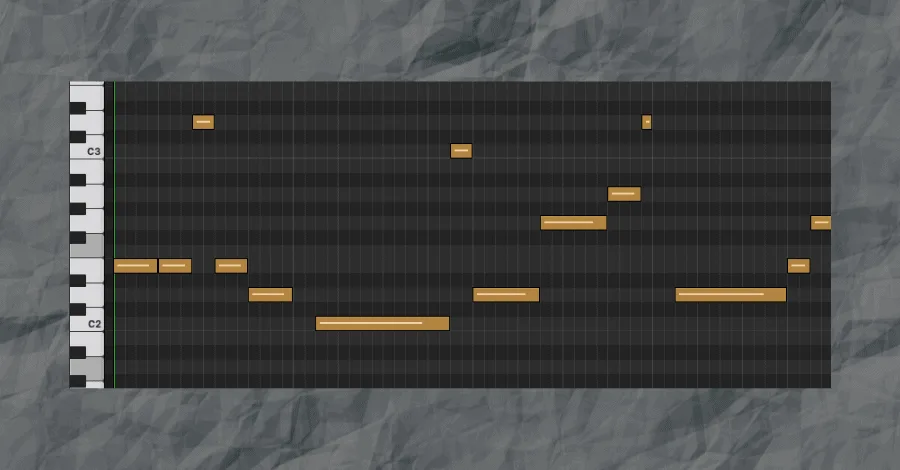
Finally, once you have a cool bass line loop, you need to extend it out through the whole track. For this step, I recommend the “copy-paste-change” approach. Write a 1 or 2 bar bass line, and then apply the copy, paste, and change it:
- Copy your 1 bar rhythm, paste it to the next bar, change one thing in that second bar.
- Then, copy your new two bar rhythm, paste it into the following two bars, and change one thing in the second two bars. Repeat again with 4 bars, 8 bars, etc.
- Do this until you have an 8 or 16 bar rhythm that is mostly the same, but with these little, unique variations included throughout.
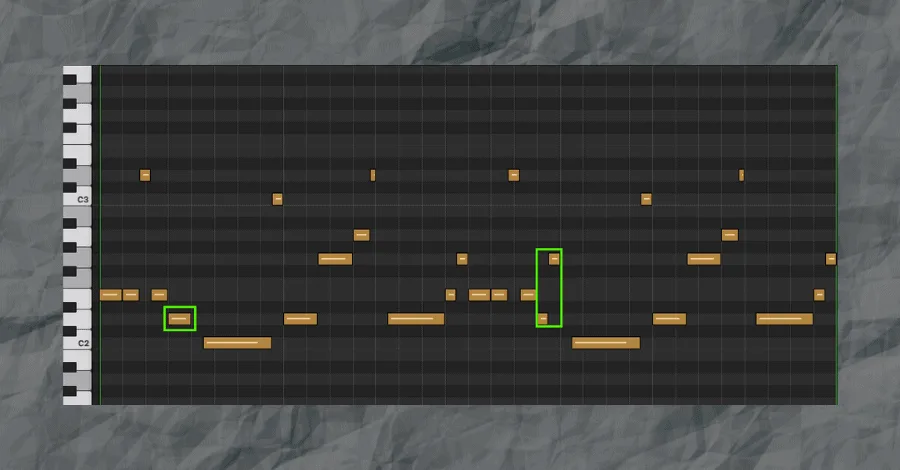
Here, there are two modified notes in the second four bars. Small changes, big payoff in how the track evolves over time.
How to Write Bass Lines: Main Takeaways
Now you have a toolbox for writing bass melodies and writing bass rhythms. But how do you know when to apply which strategies? It all comes down to the role your bass will play in your track. First, I’m going to give you an 80/20 rule. 80% of your bass line should be an extension of your chords and lead. Whether that is in melody or rhythm, your bass line has to gel with the other melodic elements in your track. The last 20% is new variation you’re adding, either in melody or in rhythm.
How do we apply this in practice?
If you’re adding tons of new rhythm, keep the melody pretty simple. If you’re adding a lot of new, interesting notes, dial back on your rhythmic variations. If your lead or chords are the main focus of the track, use a simple bass line to support them and not steal the spotlight away. If your lead and chords are simple, get the creative juices flowing and explore more variation in the melody and rhythm of your bass.
And finally, your bass should help tell a story over the course of your track. Don’t be afraid to evolve your bass progression throughout the course of the song. For example, start your song by just playing the root note of each chord as your bass line, but play some new notes when the second drop hits (again, keep 80% of your bass line the same, and add that new variation in the last 20%).
How to Produce Bass Lines
This guide focuses on writing, not producing, so I won’t go deep into production here. But here are resources to explore that step further on your own.
Sound Design
- Check out our philosophy on sound design.
- Our #1 tip for effective sound design is not making sounds from scratch, but instead using sample packs or sound banks.
- Serum is one of the most powerful synths available for making basses. Here are 12 Serum sound design tips you need to know.
Mixing
- Get started with our keys to mixing electronic music with this free mixing workshop.
- Saturation and distortion are absolutely critical when mixing basses. Check out this other free saturation workshop to learn all about them.
- To go even deeper into mixing (and all things music production), check out the Hyperbits Masterclass.
Matching the Bass to a Good Kick
This is absolutely essential. Your bass and your kick need to be in conversation with each other in order to get the most out of the awesome bass line you’ve created.
- Download some of our favorite kicks with our two free sample packs: Sample Pack Vol. 1 and Sample Pack Vol. 2.
- We figured out a way to sample the kick from ANY song (seriously, it actually works…).
Start with the writing, then layer in the production. The bass line is the foundation everything else is built on.
Now Get Back to Your DAW and Make It Groove
And now, dear reader, I send you off into the world (or, back to your DAW…) to create your own, top-tier bass lines. Remember, in the end, nearly all of us are making dance music, so your bass line should make you want to dance. This does not necessarily mean that you need more complexity in your bass line, it just means that you need something that is going to add groove and weight to the rest of your track.
If you think of your chords and lead as a starting point, your bass is an extension of these other ideas to help them work on a dance floor. Use the tips above, remember to keep things simple (and add 20% of variation along the way), and you’ll be well on your way to effectively writing bass lines in electronic music.