Jump to a section9
Buying a hardware synth is a different kind of shopping than buying plugins. There’s no demo to download, and you need cables and an audio interface before a synth even talks to your DAW. But if you already know your way around a software synth and want real knobs under your hands, here’s where I’d start.
For most producers, the safest first hardware synth is the Korg minilogue xd, at about $700. It plays chords, and almost everything on it has its own knob, so there’s very little menu diving. If you mostly write basslines and leads, the Korg monologue is an analog synth with keys for about $400. And if you’re under $300, the Behringer Model D brings the classic Minimoog sound down to about $249.
I’ll be honest: this is a hardware list from someone who chose not to use hardware. I’ve owned a Prophet and a Minimoog, and both sounded beautiful. But I’m too obsessed with speed and workflow to build hardware into how I work, so my sounds come from software synths. My first was Sylenth, then Massive, then Diva, then Serum.
I love producers who use hardware when it works for them. It’s just not for me. So these picks come from two places: I know what great hardware sounds like, and I’m obsessive about how fast a synth gets you to a good sound.
One more thing before the list: you don’t need hardware to make music. If you catch yourself blaming the gear you don’t own for the tracks you haven’t finished, a new synth won’t fix that. Trust me on this one.
Quick Picks
Click any synth to jump to its full entry.
| Synth | Best for | Why |
|---|---|---|
| Korg minilogue xd | Safest first synth | Four-voice chords with a sequencer and effects, about $700 |
| Korg monologue | Analog with keys | Keys and a sequencer for about $400 |
| Behringer Model D | Minimoog sound, cheap | Three oscillators and a ladder filter for about $249 |
| Behringer Crave | Learning to patch | Semi-modular analog for about $189 |
| Roland S-1 | Smallest budget for chords | Four voices on battery power, about $270 |
| Arturia MicroFreak | Strange sounds | 21 oscillator modes into an analog filter |
| Novation Bass Station II | Bass and acid | Full-size keys and a dedicated acid filter |
| Moog Messenger | A Moog with keys | 32 full-size keys and a 64-step sequencer |
| Behringer Pro-800 | Analog chords, cheap | Eight analog voices for about $379 |
| Arturia MiniFreak | Coming from plugins | Six voices with effects built in |
How I Picked These
I picked these based on my own experience with hardware, what my producer friends use, a lot of public reviews, and a whole hell of a lot of research. Every one is still being made and costs about $700 or less. And each one teaches you something that’s harder to learn with a mouse. (Plenty of cheap hardware is fun for an afternoon and then lives in a drawer.)
Prices are what you’d typically pay in the US, at the maker’s own store or a big US retailer. Synths go on sale a lot, and buying used can save you even more.
Pick a Synth Based on What You Want to Play
What you want to play matters more than what it costs. Find the line that sounds like you and start with those picks.
- Basslines and leads, one note at a time. Korg monologue, Bass Station II, Moog Minitaur or the Moog Messenger.
- Chords and pads. Korg minilogue xd, Behringer Pro-800, Arturia MiniFreak, or the Roland S-1 on a tight budget.
- Learning how a synth works by patching it. Behringer Crave, Behringer Model D or the Moog Mother-32.
- Textures and weird stuff, like granular or a vocoder. Arturia MicroFreak or the Arturia MiniFreak.
- Almost no room on the desk. Roland S-1, Behringer Model D or the Moog Minitaur.
How to Choose Your First Synth
Four questions, roughly in the order they matter.
Single notes or chords? A monophonic synth plays one note at a time. That covers basslines, leads, arps and a lot of sound design, and it’s how most classic analog synths work. A polyphonic synth plays several notes at once, so it handles chords and pads. Paraphonic sits in between: you can hold several notes, but they share one filter, so the whole chord gets shaped together. If your music is built on chords and you only want one synth, get a poly.
Analog, hybrid or digital? Analog means real circuits make the sound. Digital means a chip does, often copying a classic analog synth, the way the S-1 copies Roland’s SH-101. Hybrid is a mix of both. The comparison table labels every pick.
Don’t overthink this one. Analog isn’t automatically better. The truth is, once a part is in a finished mix, it’s really hard to tell which kind made it. What actually changes is how it feels to play and how fast you get to a sound you like.
Keys or a desktop module? Six of these twelve have no keyboard. You play them from a MIDI keyboard you probably already own, or straight from your DAW’s piano roll, which is how a lot of producers use hardware anyway. Desktop units take less space and usually cost less. Keys are worth paying for if you like to jam ideas out by hand, or if the synth will be your only controller.
How will it get into your DAW? You need two connections. MIDI (over USB or a 5-pin cable) sends notes and knob moves, so your DAW can play the synth and record what you do. The sound itself comes out of a separate 1/4” jack and goes into an audio interface. The Roland S-1 is the exception: its USB-C port sends both, so one cable does it all. Otherwise, budget for an interface and a couple of cables.
Pro Tip: Before buying hardware, learn at least one software synth inside and out. Once you understand oscillators, filters, envelopes and LFOs on a plugin, every knob on a hardware synth makes sense the day it arrives, and you’ll spend your time making sounds instead of reading the manual.
Best Monophonic Synths for Beginners
Seven synths that play one note at a time, cheapest first. Mono is where most classic analog sounds live, and it’s the simplest way to learn what each section of a synth does.
1. Behringer Crave
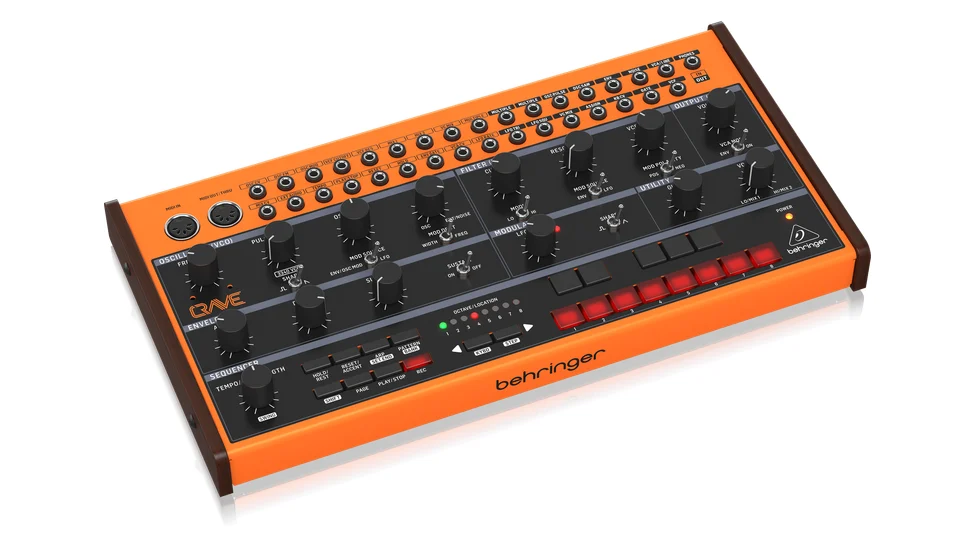
About $189 buys you a real analog synth in the Behringer Crave, with patch points waiting for the day you want to start plugging cables in.
Engine: analog, one 3340 oscillator, ladder filter
Voices and keys: mono, no keys (desktop, semi-modular)
Sequencer: 32 steps, plus an arpeggiator
Price: about $189
One oscillator sounds like a limitation, and it is one. It also means every knob does something you can hear right away. The sequencer gets a bassline going without a keyboard plugged in.
The patch points are the reason to pick it over the Model D. It sounds good with no cables at all, and once you do patch it, you’re learning modular synths on a cheap box before you spend real money.
Best for: learning how a synth works, one patch cable at a time.
Watch out: there’s no keyboard, and Behringer’s quality control has a mixed reputation, so buy from a store with an easy return policy.
2. Behringer Model D
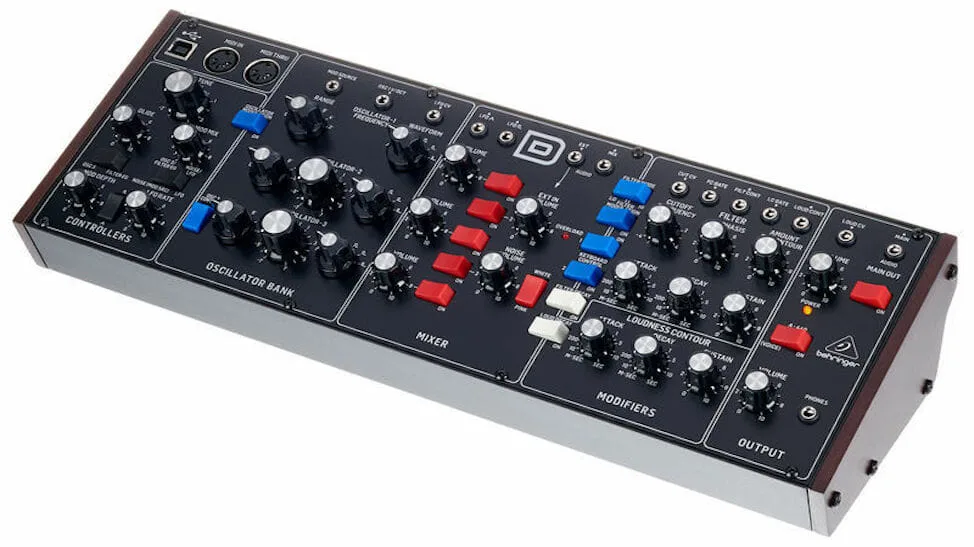
Behringer built the Model D as a desktop version of the 1970 Minimoog Model D. It isn’t a Moog, but it sounds pretty damn close.
Engine: analog, three oscillators, 24dB ladder filter
Voices and keys: mono, no keys (desktop, Eurorack format)
Sequencer: none; MIDI over 5-pin and USB
Price: about $249
Three oscillators is the headline. Stack them, detune them a hair, and you get the fat, slightly unstable bass and lead sound the original made famous.
You never have to patch it. But the patch points are there, and it fits into a modular case later if you go down that road.
Best for: fat Minimoog-style bass and leads from a box that fits next to your laptop.
Watch out: with no keyboard and no sequencer, it needs a MIDI keyboard or your DAW to play it. Stock comes and goes at some retailers.
3. Korg monologue
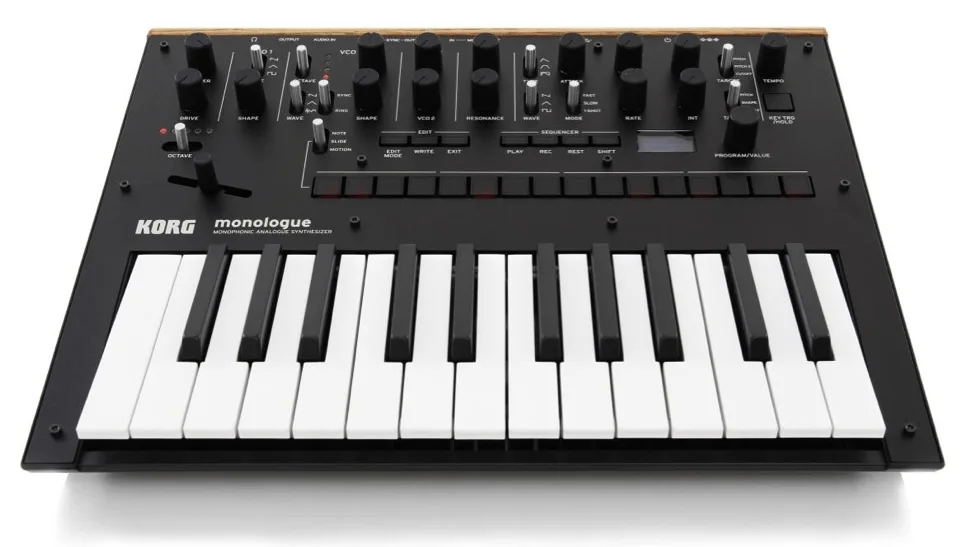
The Korg monologue is the cheapest analog synth here that comes with both keys and a sequencer.
Engine: analog, two oscillators, built-in drive
Voices and keys: mono, 25 slim keys with velocity
Sequencer: 16 steps, with motion sequencing on up to four knobs
Price: about $400 (black)
Motion sequencing is the feature to learn. You record a knob move, like the filter opening over a bar, and the sequencer plays it back every loop. It’s the same idea as automation in your DAW, just with your hand on a real knob, and it makes the monologue sound a lot bigger than you’d expect.
It also runs on batteries, so it can come to the couch with you. And the little screen shows the sound wave changing as you turn knobs. Small thing, pretty good teacher.
Best for: basslines and leads you can play and automate on one small keyboard.
Watch out: it’s mono only, and the silver version costs about $50 more than the black one.
4. Moog Minitaur
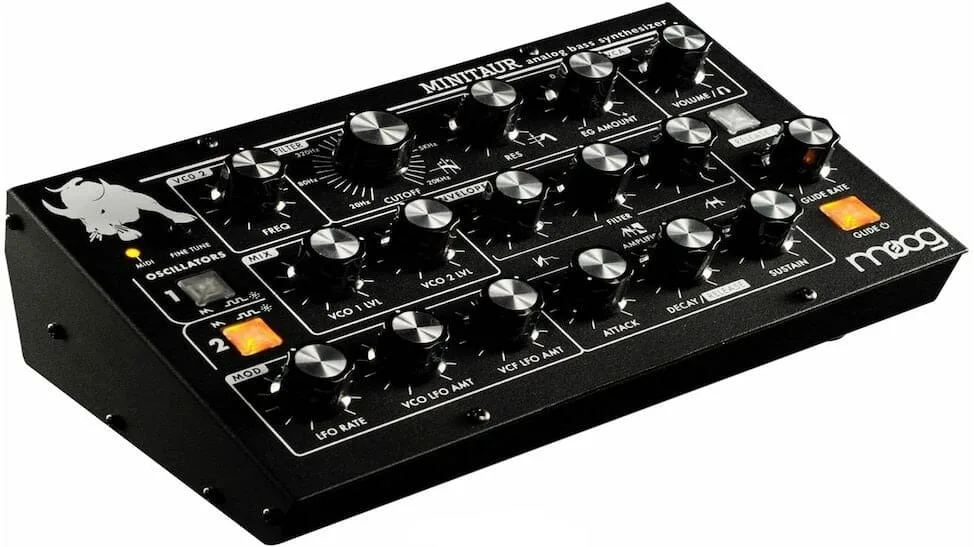
Deep Moog bass is the one job the Moog Minitaur was built for.
Engine: analog, two oscillators with hard sync, Moog ladder filter
Voices and keys: mono, no keys (desktop)
Sequencer: none; free editor for control from your DAW over USB
Price: about $599
If you make deep house or techno, you already know what this box does. A free editor puts the whole thing inside your DAW, and you can save your sounds.
Fair warning: once you hear a Moog filter on your own bassline, you’ll start eyeing their bigger synths almost immediately.
“I think lately the Moog Minitaur has really helped with those warm basslines. The Moog has such a unique sound when it comes to bass. I used it on the bassline for ‘Reach Out’ with Bontan that did really well.” - Sonny Fodera
Best for: deep Moog bass with nothing extra in the way.
Watch out: it costs about the same as the Bass Station II, which adds keys and a sequencer. Pick the Minitaur when that bass sound is specifically what you’re after.
5. Moog Mother-32
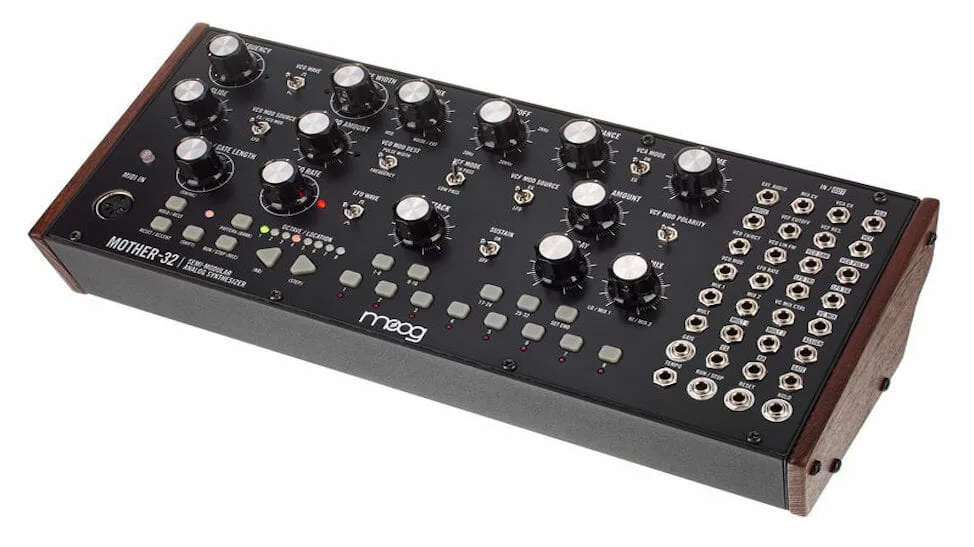
The Moog Mother-32 is a semi-modular Moog with its own sequencer, and it gets more interesting with every cable you plug in.
Engine: analog, one oscillator (saw and pulse), ladder filter with low-pass and high-pass modes
Voices and keys: mono, no keys (desktop, Eurorack-mountable)
Sequencer: 32 steps, 64 sequence slots
Price: about $599
There are 32 patch points and five cables in the box, so you start patching the day it arrives. The sequencer is the place to begin. Program a pattern, then patch the sequencer into the filter, and the line turns into something you’d never have played by hand.
Your DAW can play it over MIDI, and it can connect to other modular gear later.
Best for: producers curious about modular who want the real Moog filter from day one.
Watch out: there’s one oscillator and no keyboard. It also only takes MIDI over an old-school 5-pin cable, so make sure your interface or keyboard has one.
6. Novation Bass Station II
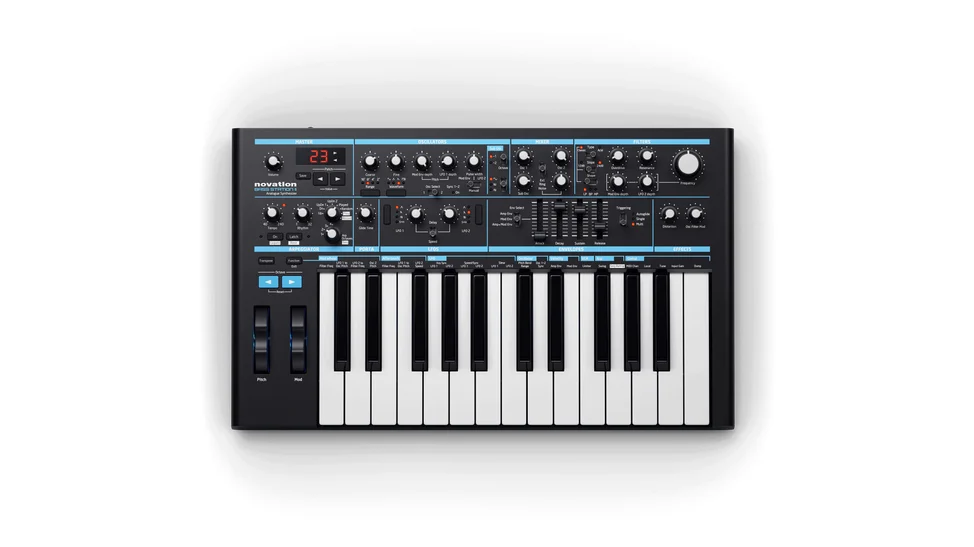
You get two filters and 25 full-size keys on the Novation Bass Station II, an analog mono synth.
Engine: analog, two oscillators plus a sub oscillator, two filters
Voices and keys: mono (with a two-note paraphonic mode), 25 full-size keys with aftertouch
Sequencer: 32 steps, plus an arpeggiator
Price: about $600
The second filter is the fun part. It’s an Acid filter, made for squelchy 303-style lines. Switch between the two and you can hear it immediately: the same sound goes from round sub bass to acid.
It runs on USB power, and the full-size keys make it a decent everyday controller for your plugins too.
“The Novation Bass Station 2. It is a great synth! … It also has a great arpeggiator function.” - Sonny Fodera
Best for: bass and acid lines with real keys under your hands.
Watch out: the paraphonic mode gives you two notes, enough for intervals and not much more. Treat it as a mono synth.
7. Moog Messenger
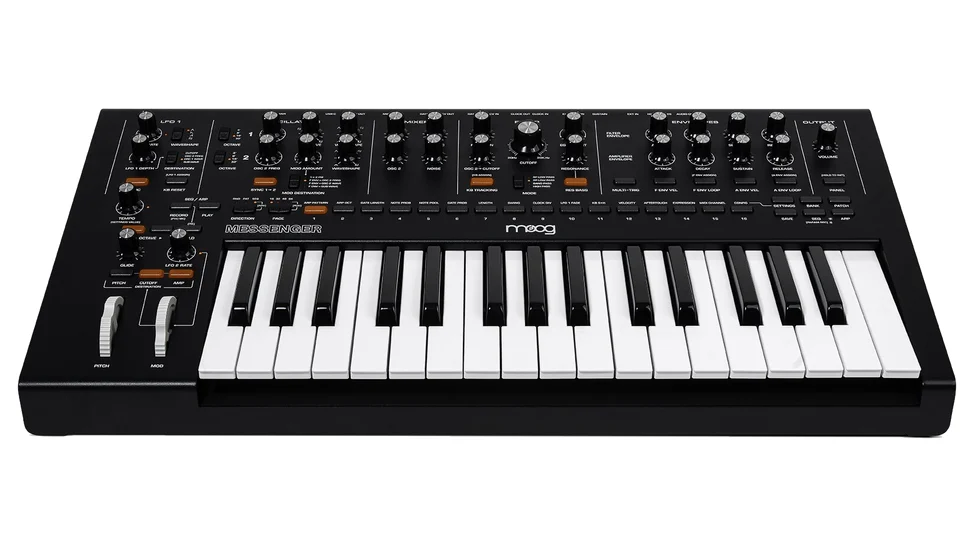
Moog made the Messenger for people new to synths, and it’s the only Moog with keys on this list.
Engine: analog, two oscillators with wavefolding plus a sub oscillator, Moog ladder filter
Voices and keys: mono, 32 full-size semi-weighted keys with aftertouch
Sequencer: 64 steps with probability, plus an arpeggiator
Price: about $699
Thirty-two keys is a sweet spot: enough to play a real bassline with two hands without taking over your desk. The filter has two flavors, and the low end stays full even when you crank the resonance.
The wavefolding lets it get brighter and buzzier than the usual round Moog sound. It talks to your DAW over USB-C.
Best for: a real Moog with keys at entry-level money.
Watch out: it’s the most expensive mono synth here, and it’s still mono.
Best Polyphonic and Paraphonic Synths for Beginners
Five synths that play chords, cheapest first. One of them, the MicroFreak, is paraphonic, and its entry explains what that costs you.
8. Roland S-1
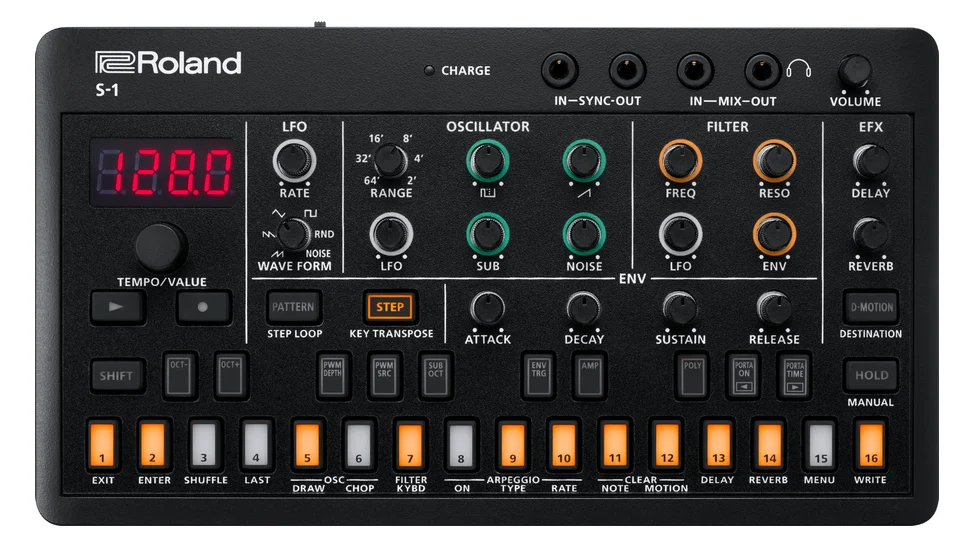
Roland’s S-1 is a remake of the classic SH-101, small enough to disappear into a backpack.
Engine: digital, modeling the SH-101
Voices and keys: 4 voices (mono, poly, unison and chord modes), pads, no keyboard
Sequencer: 64 steps
Price: about $270
The original only played one note at a time. The S-1 plays four, so you get chords, plus delay, reverb and chorus built in. It nails that bright, bouncy 101 sound.
The USB-C port is the sneaky best feature. One cable into your laptop records it straight into your DAW, no audio interface needed. The battery lasts about four and a half hours. If it hooks you, Roland’s Boutique modules are the step up: small remakes of the Juno and other classics, at about $480 each.
Best for: chords and a classic Roland sound on the smallest budget and the smallest desk.
Watch out: the pads take getting used to, so you’ll probably end up playing it from a MIDI keyboard or your DAW.
9. Arturia MicroFreak
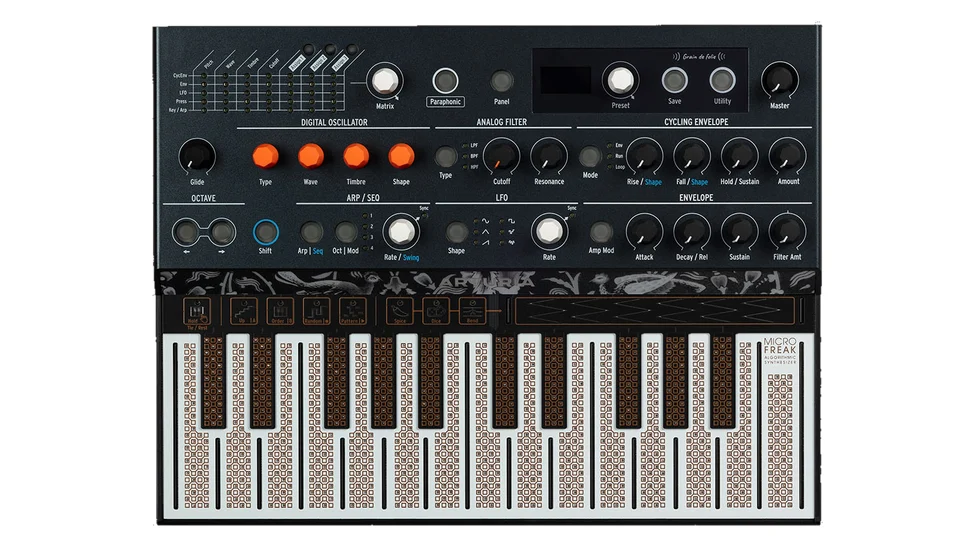
The Arturia MicroFreak sends a digital sound source into a real analog filter. On this list, only its bigger sibling, the MiniFreak, makes the same kind of sounds.
Engine: hybrid, digital oscillator with 21 modes, analog state-variable filter
Voices and keys: paraphonic up to 4 voices, 25-key flat capacitive keybed with poly aftertouch
Sequencer: 64 steps, plus an arpeggiator
Price: about $349 (Arturia lists it at $399)
That sound source does wavetable, granular, samples and a vocoder, plus engines borrowed from Mutable Instruments and Noise Engineering, two well-known modular makers.
The keyboard is the part people underestimate. It’s flat, like a touch surface, so it doesn’t play like normal keys, but each key responds to how hard you press. That’s rare at any price. Press harder on one note of a chord and only that note changes.
Best for: strange, modern sounds a classic subtractive synth can’t make.
Watch out: it’s paraphonic, so all four notes share one filter, and the flat keys won’t work as your main keyboard.
10. Behringer Pro-800
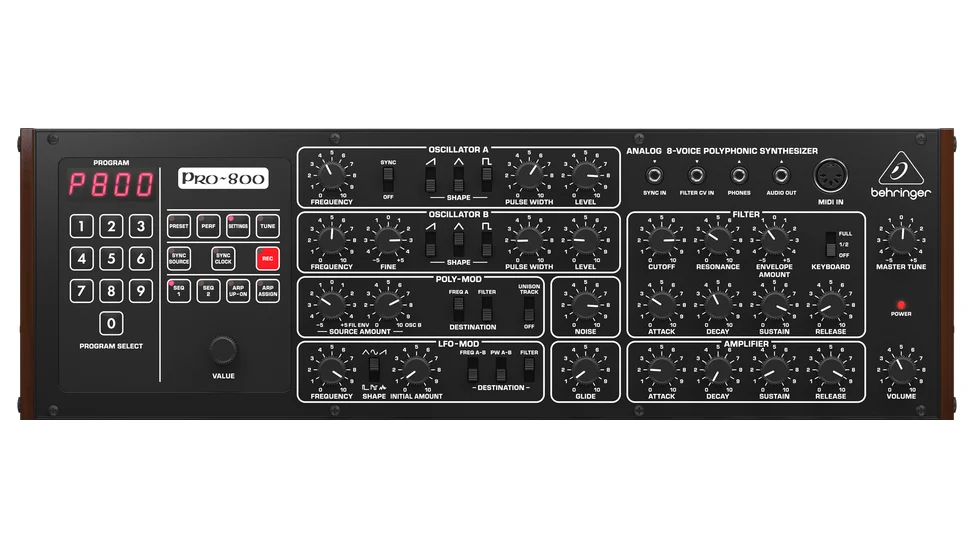
Behringer’s Pro-800 packs eight analog voices into a desktop box for about $379.
Engine: analog, two oscillators and a filter per voice, based on the Sequential Prophet-600
Voices and keys: 8 voices, no keys (desktop, Eurorack format)
Sequencer: sequencer and arpeggiator
Price: about $379
It’s the only true analog poly synth here under $500. Every note gets its own filter, so each note in a chord can swell and fade on its own, which a paraphonic synth can’t do.
It’s based on the Prophet-600 from the early ’80s, and it keeps that crowded panel, so it takes longer to learn than the Korgs.
Best for: analog pads and chords when the budget stops under $400.
Watch out: it has no keys, and it’s another Behringer, with the same mixed quality-control reputation as the Crave.
11. Arturia MiniFreak
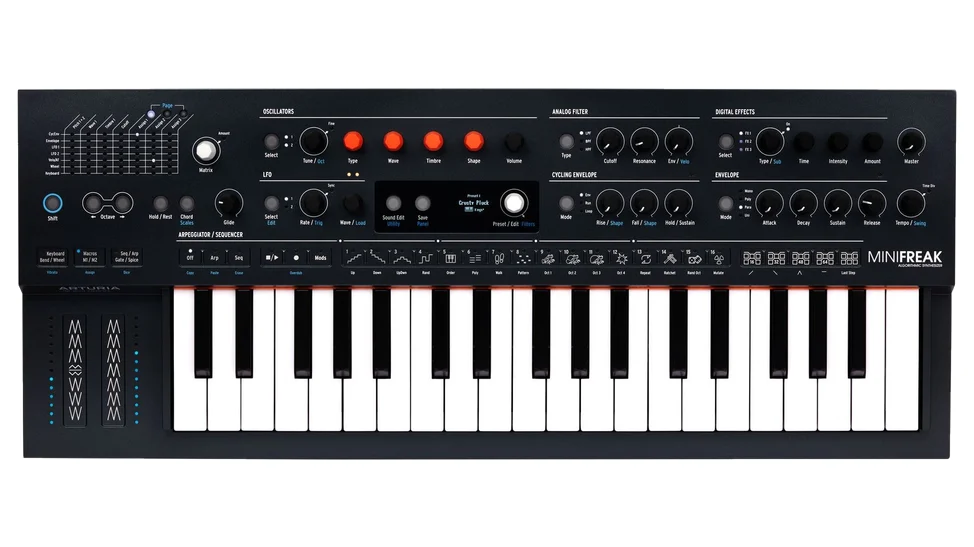
Think of the Arturia MiniFreak as the MicroFreak grown up.
Engine: hybrid, two digital engines with 22 oscillator modes, analog filters and amps per voice
Voices and keys: 6 voices (12 paraphonic), 37 slim keys with aftertouch
Sequencer: 64 steps, plus an arpeggiator
Price: about $599 (Arturia lists it at $649)
It has six real voices, so every note gets its own filter, which fixes the MicroFreak’s biggest limit. It also has more sound engines and three effects built in, so a sound is basically finished before it hits your DAW.
If you already know your way around Serum or Vital (probably you, if you’ve read this far), it’ll feel familiar fast. It’s the easiest jump on this list from plugins to hardware.
Best for: producers coming from soft synths who want modern sounds and real polyphony.
Watch out: with this many modes, it’s easy to scroll presets for an hour instead of learning the synth. The slim keys are fine for parts, less so for long two-handed playing.
12. Korg minilogue xd
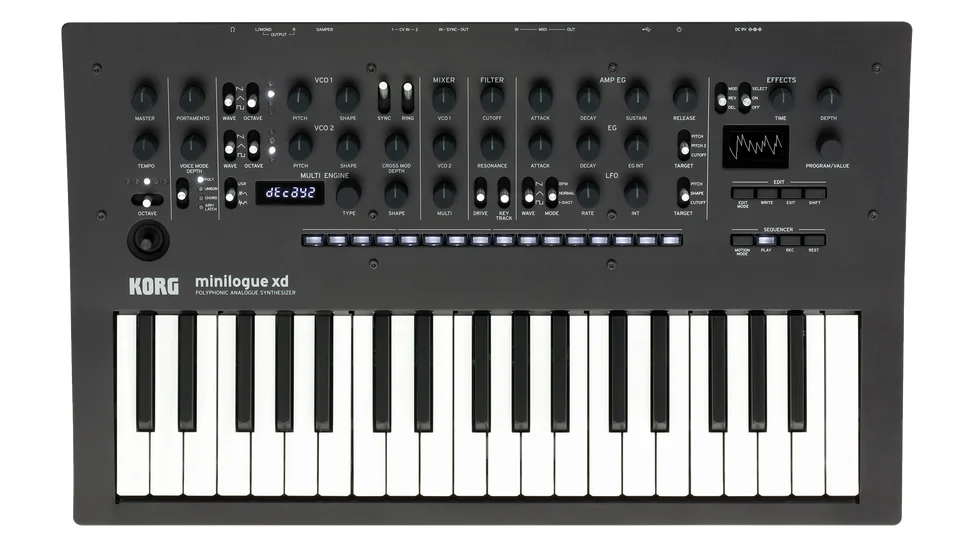
If this list could hold only one synth, it would be the Korg minilogue xd.
Engine: hybrid, four analog voices (two oscillators each) plus a digital multi-engine
Voices and keys: 4 voices (poly, unison, chord and arp modes), 37 slim keys with velocity
Sequencer: 16-step polyphonic sequencer with motion sequencing
Price: about $700
The four voices are analog, and almost everything has its own knob, so you learn by turning things. A digital engine on top takes it way past classic analog sounds.
Delay and reverb are built in, and the sequencer can record chords. The original minilogue costs about the same now, so get the xd.
Best for: chords and pads, and anyone who wants one synth that covers most jobs.
Watch out: four voices run out fast on big pads with long releases, and the slim keys feel small if you’re used to a full-size controller.
A Few More Worth Knowing About
The Korg MS-20 Mini is the step up once you outgrow the mono picks: a remake of Korg’s 1978 MS-20 with patch points, at about $900. The Moog Grandmother, about $999, is the stretch if you want a keyboard Moog you can patch. At the cheap end, Korg’s volca bass (about $130 to $160) and the Behringer TD-3 (about $149) are tiny analog boxes for bass and acid. And the Roland J-6, about $270, is a chord machine for producers who don’t play keys.
All 12 Side by Side
| Synth | Voices | Engine | Keys | Sequencer | Price |
|---|---|---|---|---|---|
| Behringer Crave | Mono | Analog | None | 32 steps + arp | about $189 |
| Behringer Model D | Mono | Analog | None | None | about $249 |
| Korg monologue | Mono | Analog | 25 slim | 16 steps | about $400 |
| Moog Minitaur | Mono | Analog | None | None | about $599 |
| Moog Mother-32 | Mono | Analog | None | 32 steps | about $599 |
| Novation Bass Station II | Mono (2-note paraphonic) | Analog | 25 full-size | 32 steps + arp | about $600 |
| Moog Messenger | Mono | Analog | 32 full-size | 64 steps + arp | about $699 |
| Roland S-1 | 4 | Digital | Pads | 64 steps | about $270 |
| Arturia MicroFreak | 4 paraphonic | Hybrid | 25 flat touch | 64 steps + arp | about $349 |
| Behringer Pro-800 | 8 | Analog | None | Yes + arp | about $379 |
| Arturia MiniFreak | 6 | Hybrid | 37 slim | 64 steps + arp | about $599 |
| Korg minilogue xd | 4 | Hybrid | 37 slim | 16 steps | about $700 |
Buying Used, and the 20-Minute Test
Every price on this page is for a new synth. Used gear saves real money, and it opens up the vintage world too, from Juno-106s to DX7s. Vintage prices climb fast, though, and repairs come with the territory.
Whatever you buy used, play it for at least 20 minutes before you pay. Some faults only show up once an old synth warms up, like crackling oscillators or a voice that drops out, and you want to hear that while you’re still standing in the seller’s living room.
New or used, a cheap cable or a noisy interface will make any synth sound worse once it hits your DAW, so don’t skimp on the audio interface.
Frequently Asked Questions
Which hardware synth is best for beginners?
For most producers, the Korg minilogue xd. It plays chords, and nearly every function has its own knob, so it covers a lot of jobs and stays easy to learn. The sequencer and effects are built in too. If you mostly make basslines and leads, the Korg monologue or the Novation Bass Station II costs less. Under $300, look at the Behringer Model D or the Roland S-1.
Are hardware synths worth it if I already use plugins?
They can be. A good plugin can sound every bit as good as hardware. The difference is the workflow: a knob for every function, and no preset browser one click away. If you’ve learned one soft synth well and want to get your hands off the mouse, it’s worth it. If you haven’t, learn the plugin first. It’s free or close to it, and everything you learn carries over.
Do hardware synths sound better than plugins?
Not automatically. Modern plugins model analog circuits closely, and in a finished mix it’s very hard to hear which one made a part. Hardware gives you a different way of working, and that often leads to different ideas. Buy one because you want to play it, and don’t expect it to fix a mix.
Should my first synth be analog or digital?
Either works. Analog synths tend to have fewer menus and one knob per function, which makes them good teachers. Digital and hybrid synths cover more ground, from wavetables to granular textures, and often cost less for the features. If you want the most flexible single synth, a hybrid like the minilogue xd or the MiniFreak splits the difference.
Should my first synth be polyphonic?
If you write chords and pads and you only want one synth, yes. A poly like the minilogue xd handles chords and still does bass and leads. If you mostly want basslines and leads, a mono synth is cheaper and simpler, and it teaches the same fundamentals.
Do I need a keyboard, or is a desktop synth fine?
A desktop synth is fine if you already have a MIDI keyboard, or if you’re happy to program parts in your DAW’s piano roll. Desktop units cost less and take less space. Get a synth with keys if it’ll be your only controller or if you like to jam ideas out by hand.
What do I need to connect a hardware synth to my DAW?
Usually an audio interface and two cables. An instrument cable carries the sound into your interface and onto a track. A USB or MIDI cable carries the notes, so your DAW can play the synth and record your performance. The Roland S-1 is a handy exception: it sends audio and MIDI over a single USB-C cable.
What is the cheapest real analog synth?
On this list, the Behringer Crave at about $189. Go smaller and Korg’s volca bass (about $130 to $160) and the Behringer TD-3 (about $149) are analog too, in much smaller formats with fewer controls.
Learn One Synth Like the Back of Your Hand
The best first synth is the one you actually learn, and that matters more than which badge is on the panel.
If you just want me to pick:
- One synth for everything. Korg minilogue xd, about $700.
- Bass and leads on a budget. Korg monologue, about $400.
- Under $300. Behringer Model D for mono, Roland S-1 for chords.
- Bass with real keys. Novation Bass Station II, about $600.
- Coming from plugins. Arturia MiniFreak, about $599.
Whatever you buy, give it a month before you buy anything else. Make one sound from scratch every day and record it into your DAW. Then actually put it in a track. Thirty days of that and you’ll know the thing like the back of your hand.
If a month in you still reach for a plugin first, that’s an answer too. It’s where I ended up, for what it’s worth.
And a synth only gives you sounds. Turning them into finished records takes hundreds of tiny arrangement and mixing decisions, and that’s what the Masterclass is built to teach.
Have a question about a synth, or think something belongs on this list? Send us a message and we’ll take a look.
Heads up: some of the links below are affiliate links. If you buy through one, we earn a small cut (costs you nothing extra). But we'd point you at this exact gear whether we made a dime or not. As an Amazon Associate, we earn from qualifying purchases.