


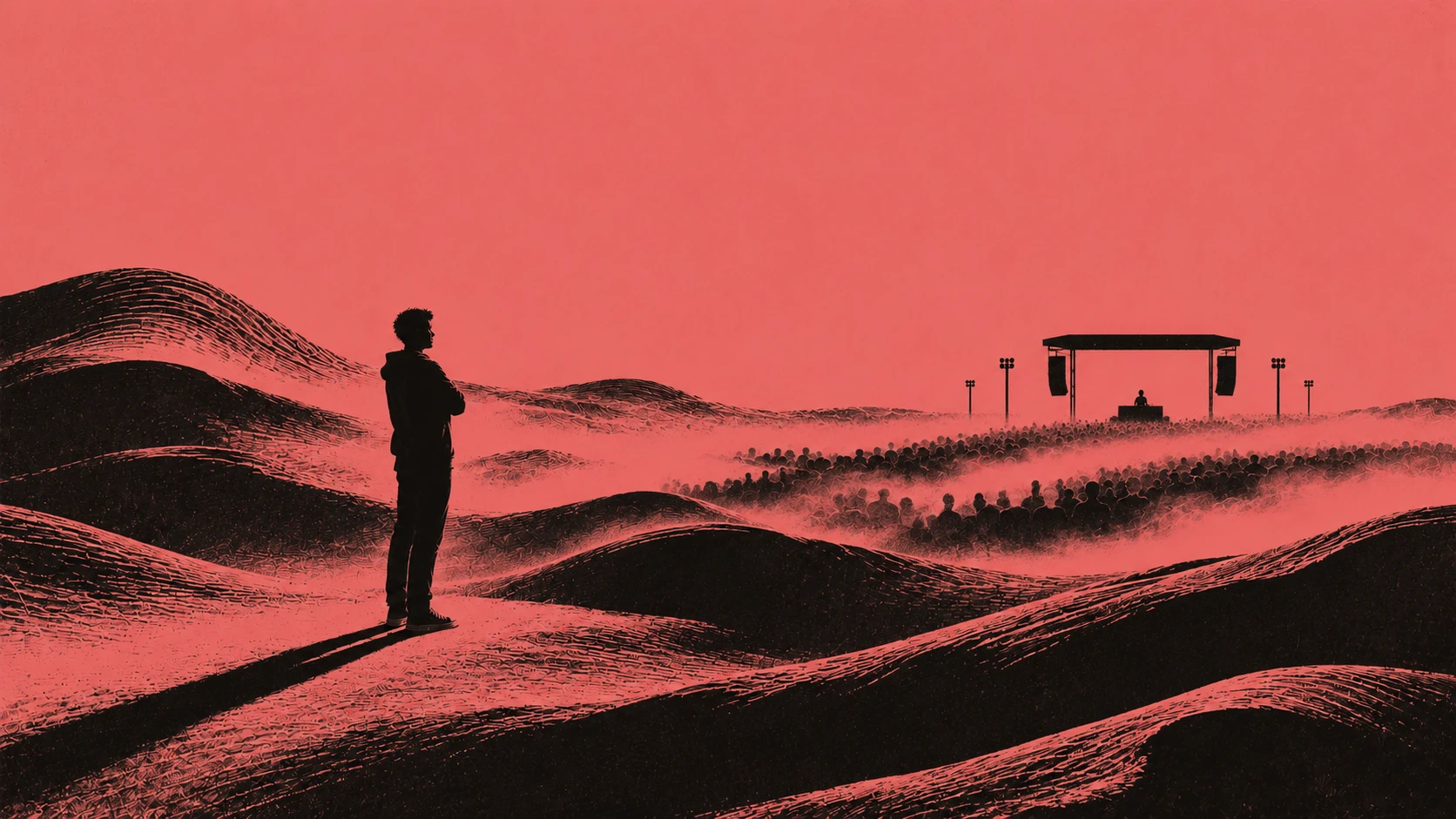
Anyone else feeling jaded? AI music is everywhere. Suno can spit out in thirty seconds what took you years to get half decent at.
But nobody actually likes and listens to that AI music stuff, right?
Then you scroll the comments on Instagram under an AI song and read: “this is the greatest song ever.”
You shake it off and go back to making real music. At least that still feels good.
Except the last time you made something you actually loved, no label even answered the email.
And when one finally does? They want 50 to 80% of the master. Plus a bunch of content: a handful of reels, DJ sets and YouTube videos, only to send you a royalty statement that somehow says you owe them.
I get it. It can feel bleak out there.
If you nodded along while you read all that, stick with me. I’m not going to tell you it’s all fine. But I think a lot of producers are about to make a decision based on a story that isn’t true.
I feel it too
My fiancée once asked me why I wasn’t dancing.
We were at a festival, 150,000 people losing their minds, and I was standing there with my arms crossed, picking the track apart. The vocal. The drop. That same bass sound again.
I didn’t have a good answer. Because “this drop is mid” isn’t one.
It also makes me pretty dull company at a festival.
And lately there’s plenty to feed that mood. A friend of mine just got back from ADE, and a lot of the artists he talked to sounded beaten down. AI tracks charting. Questions about whether labels are even worth it anymore, when “marketing” means a couple of reels and a spot on a playlist the label already owns. Then a royalty statement you’d rather not open.
Those complaints are real. I’m not going to pretend they aren’t.
The script running in your head
But feeling “jaded” rarely shows up as a big dramatic moment. It shows up as one quiet sentence you start believing:
What’s the point?
The game is rigged. The audience has bad taste. AI is going to flood everything anyway. So why spend another Saturday on a track nobody’s going to hear?
And here’s where it starts to cost you. Not money. Headspace. That question doesn’t stay at the festival. It follows you into the studio.
You open a project you loved three days ago and start wondering who would even listen to it. It doesn’t sound like what’s getting signed. You have no idea how you’d promote it. Someone with a bigger following will put out something similar anyway.
You haven’t finished the second verse, and you’re already disappointed with the release.
That’s a lot to decide about a song nobody has heard yet.
Notice something about all that? Look at the list again:
- Who would even listen.
- Whether it sounds like what’s getting signed.
- How you’d promote it.
- Whether someone bigger beats you to it.
Every one of those is a prediction. You’re forecasting how the track will land before it even exists.
And the whole thing rests on one assumption: that somebody out there knows what’s going to work, and it isn’t you.
That assumption is wrong.
Nobody knows. Not even Sony.
That same friend was at a Sony party at ADE a couple of years ago. He ended up talking to two of the label’s data scientists.
These are people with more data than you or I will ever see. So he asked them: you must know exactly what’s going to chart, right? What’s going to be huge next?
Their answer: nah. No idea. They were actually worried about their jobs.
The people paid to see it coming, effectively, can’t.
And if the people with all the data can’t predict what’s going to work, your cynicism can’t either.
Meanwhile, two aliens from Quebec
Here’s my favorite counterexample to “nobody cares about art anymore.”
Angine de Poitrine are a duo from Saguenay, Quebec. They play microtonal math rock on guitars with extra frets, so they can hit the notes between the notes. They perform in polka-dot suits and giant papier-mâché masks. They only speak in robot voices.
On paper, that’s the least viral thing imaginable.
Their KEXP session has millions of views. Watch a few minutes and you’ll see why.
They won the 2026 Polaris Music Prize. And they’re selling out shows across the US, in the same year AI tracks and the simplest songs in the world are topping the charts.
Nobody predicted that. Nobody could have.
So the next time you’re certain there’s no audience for something strange, remember: the strange thing just sold out a US tour.
A note to my own inner critic
I still hear huge records and think, “Really? This one?”
Fine. I don’t have to like every record. My taste is trained, and it’s allowed to be picky. It’s also mine, and millions of people with different taste aren’t wrong for loving what they love.
What I’ve learned is that being annoyed by other people’s taste does exactly nothing for my own music.
Being “jaded” is usually taste morphing into contempt. And I promise you, contempt doesn’t get you very far, let alone to finishing music you’re proud of.
Jaded is just taste with nowhere to go.
So give it somewhere to go
If nobody knows what’s going to work, then chasing what’s working becomes a very crowded bet. Every producer copying this month’s sound is effectively fighting for the same spot in the pecking order.
To me, this means the weird thing only you would make might be the best bet, because no one else is making it.
So here’s what I’d do this week.
Open a project you still have some affection for. Not the safe one. The one you got excited about before the “who would even listen” voice showed up.
Pick one thing and finish it. The arrangement. The vocal that feels a little too exposed. The transition you’ve avoided for three sessions.
Give it a full hour before you check what anyone else released. The charts will still be there. So will everything you can complain about.
At least you’ll have moved your track forward.
And if you want someone to show you how to tell whether something actually works, before the cynic in your head decides for you, that’s what we do inside the Hyperbits Masterclass. Real instructors, listening to your actual tracks, helping you build a sound nobody else can make.