
Jump to a section15
- The invisible scripts that keep you stuck
- Stop asking $3 questions
- The loop: how every song teaches you something
- 1Pick a song you love
- 2Build yours on top of it
- 3Finish it by a deadline
- 4Get it heard
- 5Learn one thing, then go again
- Why every song has to be a whole song
- Your first song, this week
- Can you teach yourself music production?
- How long does it take to learn music production?
- Should you take a course or go to school?
- Questions people ask about learning music production
- Start ugly, finish often
Three or four songs a year.
That’s how many tracks I finished when I first got serious about production. A few years later, I finished over 40 in a single year.
Same guy. Back then I had a marketing job I hated and a pile of courses I’d paid for, plus a music school in New York City, and I still couldn’t get a song from an idea to the end. What changed was how I was learning.
So here’s how to learn music production: you learn it by doing it, and for a producer, doing it means making full songs, start to finish.
Loops and ideas teach you how to start a track. Finished songs teach you everything else. Every one you finish adds to the skills a producer actually needs: arranging, mixing, making hundreds of small decisions and knowing when to call it done.
Your DAW, music theory and sound selection get picked up along the way, because the song in front of you needs them.
If you want a target, make it 40 songs. The rest of this post is how to get there: the beliefs that kept me stuck for years, the loop every song goes through, the time budget I use for one song, the exact messages to send when you want feedback, and what to do this week.
The invisible scripts that keep you stuck
Ramit Sethi, who writes about money, talks a lot about invisible scripts. They’re beliefs you picked up somewhere, never decided to keep, and follow anyway.
Producers have them too. Here are the four I hear most often (I’ve believed most of them myself).
“I need to learn more before I make a real song.”
It sounds responsible. It’s also why so many producers have watched hundreds of tutorials and finished three songs.
Making a song is how you find out what you actually need to learn. Learn it then, while the song is waiting on it.
“I’ll finish it when it sounds good.”
It’ll sound good because you finished 30 songs before it.
From 2010 to 2013, my absolute minimum for one song was two months. Most of that time went into tweaking an idea that was broken from the start: one more layer, one more sample, a better master. None of it fixed the song.
“I don’t have time to finish songs.”
Most people can find one hour a day. And honestly, I’d rather you work one hour a day, seven days a week, than ten hours on one day a week.
Seven hours a week is enough to finish a song every week or two once you’re used to the time budget further down.
“I need better gear first.”
You don’t. Great music gets made with stock plugins all the time. Gear is a $3 question, to borrow another idea from Ramit.
Stop asking $3 questions
Ramit’s rule for money goes like this: people obsess over $3 questions, like whether to buy a latte, and ignore the $30,000 ones, like negotiating their salary. A handful of Big Wins matter more than a hundred small savings.
Learning production splits the same way:
| $3 questions | Big Wins |
|---|---|
| Ableton or FL Studio? | Finishing songs on a deadline |
| Which compressor is best? | Building every song on a song you love |
| 44.1 or 48 kHz? | Honest feedback on every song |
| How should I color-code my tracks? | A sound library you know like the back of your hand |
No one has ever won a Grammy because their shortcut game was great.
Here’s a thought experiment from my finishing lesson in the Masterclass. Someone hires you to write two hours of music for an indie film, and you have one week. How much time are you going to spend fine-tuning EQ?
Probably none. You’d write a great melody, make sure the kick and bass sit together, and grab the best drum samples you own.
A deadline forces you onto the Big Wins. That’s why it sits right in the middle of the loop.
The loop: how every song teaches you something
Every song you make goes through the same five stages. Run them over and over, and you’re learning production whether it feels like it or not.
- Pick a song you love. It becomes your map.
- Build yours on top of it. This is where you learn your DAW, your sounds and your chords.
- Finish it by a deadline. The most important stage, and the one most people skip.
- Get it heard. By someone who’ll tell you what’s actually wrong.
- Learn one thing, then go again. One thing. Then start the next song.
Here’s each stage in detail.
1. Pick a song you love
When I finally turned things around, the first decision I made was to study the artists I loved almost obsessively and break down exactly what they were doing.
The most practical version of this: drop a song you love straight into your DAW and mark where every section starts. Intro, verse, build, drop, breakdown, outro.
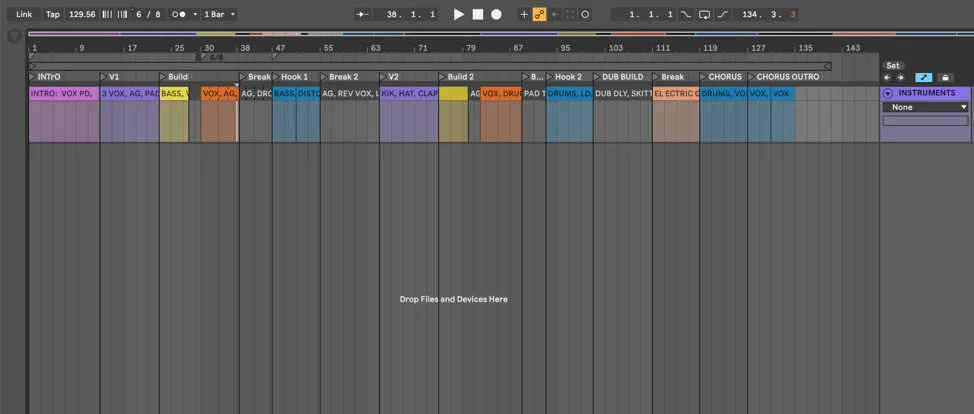
Notice what happens when you do this. You can suddenly see the gaps in your own song. And you stop looping the same eight bars for three weeks, because the reference shows you exactly what the next section needs to be.
Pick three to five reference songs per track, the handful that excite you most, and go back to them every time you get stuck. A playlist of a hundred songs won’t help you.
Referencing goes way past arrangement, too. You can check your chords, your sound choices, your mix and your loudness against the same songs. I go deep on this in how to use reference tracks.
2. Build yours on top of it
This is the stage where all the “how to” lives. The trick is learning it in the order your songs ask for it, instead of trying to learn everything before you start.
Learn your DAW once, properly
Your DAW (digital audio workstation) is the software you make music in: Ableton Live, Logic Pro, FL Studio and so on. Beginners lose months shopping between them. Pick one and stay. They all make professional records. If you’re torn, I broke down the choice in the best DAW for beginners.
Then treat it like an instrument. You’d practice a guitar. Practice your DAW.
Very early on, I spent one full day learning everything about MIDI editing in my DAW: the piano roll, quantizing, duplicating, moving notes around. One day. It paid off for years, because you spend a huge chunk of every song editing MIDI and audio, and I never had to stop and fight the software again.
Do the same for audio (cutting, warping, fading, stretching) and learn the shortcuts you’ll use a hundred times a session. Start with the Ableton shortcuts or Logic Pro shortcuts.
Start from great sounds
Beginners often think real producers design every sound from scratch. Most don’t, and you shouldn’t either at this stage.
Getting good at synthesis takes a long time, and designing every sound yourself eats the hours you should spend finishing songs. The companies making presets and samples do it all day, every day. Their sounds are usually better than what you’ll make in an evening.
So build a library of great sounds and take pride in it. Keep a favorites folder with only your absolute best samples, and when you process a sound you love, save the whole chain. In the Masterclass we teach a rule of thumb: get about 70% of the way to your reference with the sound itself, then use processing to cover the last 30%.
Hack the theory you need
You need some theory. You don’t need a degree in it. I’ve played guitar since I was a teenager and I still can’t read sheet music.
Here’s something that might surprise you: you can’t copyright a chord progression. So start from MIDI. Pull the chords from songs you love, use chord packs, reuse your own progressions from older projects, then change them until they sound like you.
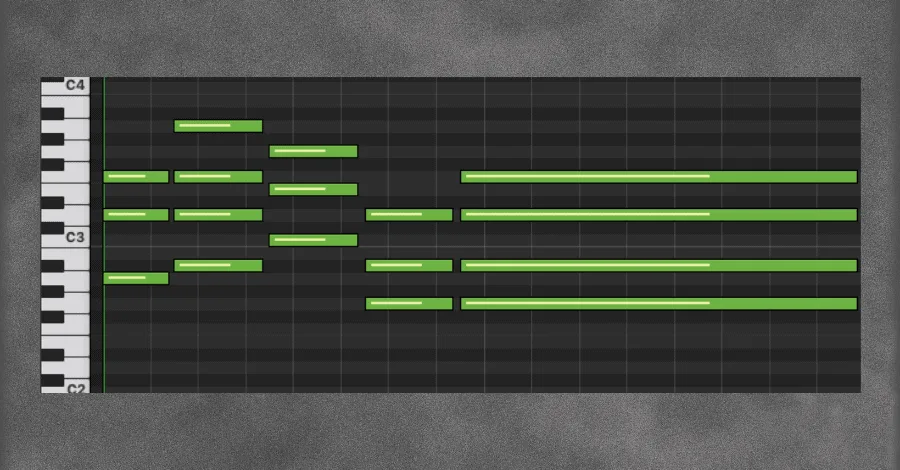
That’s the progression from Bonobo’s “Cirrus,” rebuilt in a piano roll. Change the rhythm, move a note or two, and it’s yours.
Our free pack of 350 famous MIDI chord progressions is a good place to start. When you want the real foundations, read the best way to learn music theory.
Keep it simple
My first paid remix for a major label had to be delivered in 24 hours. I was so determined to impress the label that I tried to make the most complex track of my life.
Well into the night, I had nothing. So, out of pure desperation, I Googled how to finish music on a deadline. I found a random forum post that said: when you’re stuck, go back to a simple chord progression and a simple lead.
So I did. Within a few hours I had most of the remix done, and it got approved.
When a song stalls, try taking something away before you add anything.
3. Finish it by a deadline
This is the stage that changed everything for me.
In 2013, a management team offered to represent me. We met at a bar on 37th and 9th in Manhattan, and they had one condition: a finished remix or original song every two weeks.
I was finishing three or four a year. I honestly thought they were crazy. I agreed anyway, figuring they’d forget about it.
They didn’t. They checked in constantly. One year later, I’d finished over 40 songs and remixes.
Two things changed. I had deadlines, and I stopped being a perfectionist. (I used to brag about being a perfectionist in job interviews. In music it mostly means you’re scared to let anyone hear anything.)
If I opened any of those 40 projects today, I’d change a ton. Some of them still landed with major labels.
A song is never actually done. It’s just something you decided to stop working on.
I made a two-minute video about this, built around Ira Glass’s idea of the gap: your taste is ahead of your skill for a while, and the only way through is a huge volume of work.
How long should one song take?
Here’s the time budget I teach in the Masterclass. It’s a guide for beginner and intermediate producers, and every song will bend it a little.
About 8 to 15 hours, total. If your songs keep taking months, the budget shows you where they get stuck, and that tells you what to work on next.
Make the deadline real
- Put something on the line. Tell a friend. Make a bet with someone. Social pressure plus a little money works better than any app (step 4 has a word-for-word message for this).
- Stop saving 40 versions. If you loved an idea, you’ll find it again. Commit and move forward.
- Print to audio. Bounce your MIDI and synth parts to audio once they’re working. It saves CPU and forces you to commit.
- Sleep on it. The best break is overnight. You’ll hear the problems in the morning that you couldn’t hear at 2am.
If you get stuck right at the end, use the 8-step finishing checklist.
4. Get it heard
This is the stage self-taught producers skip the longest. I get it. Showing someone your track feels terrible.
But you can’t hear your own blind spots. That’s literally what makes them blind spots. A producer who’s a few years ahead of you will hear in ten seconds what you’ve missed for months.
Most people ask for feedback like this: “Hey, what do you think of my track?” Then they get “sounds good, man” and learn nothing.
Here’s exactly what to send instead.
Copy this: asking for feedback
Hey [name], I just finished a track and I'm working on my arrangements. Could you listen to the first 90 seconds and tell me the one thing that bugs you most? Here's the song I was going for: [link to your reference]. Don't be nice, I can take it.
It’s short and specific, and it gives them a reference to compare against. Asking for one thing also makes it a lot easier to answer than “what do you think?”
Whatever they say, don’t argue. Write it down.
Start a finishing group
The single most useful thing I tell students in the Masterclass: find two or three other producers and get on a 30-minute call once a week. Everyone plays what they finished and says what they’re finishing next.
Put money on it if you can. I’ve done this in business groups: miss your goal and you owe everyone a book. With four or five people at about $20 each, missing got expensive fast, so I stopped missing.
Here’s the message to start one.
Copy this: starting a finishing group
I'm trying to finish a song every week. Want to do a 30-minute call on Sundays where we each play what we finished and say what we're finishing next? Miss your deadline, you buy everyone a coffee. In?
5. Learn one thing, then go again
Early on, a friend at my corporate job connected me with Chris Zane, the producer behind Passion Pit and Friendly Fires. I asked him the question every beginner asks: is there one thing I’m doing wrong? One reason my music doesn’t sound professional?
His answer changed how I saw everything. There isn’t one answer. Great-sounding music is hundreds, maybe thousands, of tiny decisions that add up over time.
So each song, pick one thing to get better at. Saturation on this one. Cutting with EQ on the next. Then transitions, then reverb. Every song gets a little better, and over 40 songs that stacks up into a sound you’re proud of.
How to pick your one thing: the music producer circle
Here’s an exercise from the first module of the Masterclass.
Draw a circle and cut it into eight slices: sound selection, composition, arrangement, sound design, mixing, mastering, collaboration and finishing music. In each slice, put a dot. The better you are at that skill, the closer the dot goes to the edge.
When I do it myself, sound selection and mixing land near the edge. Sound design sits pretty close to the middle. (I’ll be honest: I’m still not much of a synth nerd.)
The dot closest to the center is your one thing for the next song. Redo the circle every few songs. If the shape never changes, you’re probably avoiding your weak spots.
Why every song has to be a whole song
You’ll find roadmaps online that split production into dozens of separate drills: a project for EQ, another for reverb, another for arpeggios, each one in a random key.
I get the appeal. It feels organized. But production doesn’t come apart that cleanly.
Your arrangement decides what the mix needs. The sounds you pick decide half of the mix before you touch an EQ. The chords decide which sounds will work. And your sound, the thing that makes a track yours, shows up in every one of those decisions at once.
Practice them separately and you get good at drills. Then you sit down to make a real song and it falls apart at the seams.
So every one of your 40 songs is a complete song. What changes is where you put your attention, and the circle shows you where.
Your first song, this week
If you’ve never finished a track, here’s the whole loop, small enough to do in a week:
- Pick one song you love in the genre you want to make. The simpler its structure, the better.
- Drop it into your DAW and mark where each section starts: intro, build, drop or chorus, breakdown, outro.
- Make eight bars with drums, a bassline and a chord part. Use samples and presets. Steal the chords if you need to.
- Copy the song’s map. Stretch your eight bars across its sections. Mute and unmute parts so each section feels different.
- Do a rough mix. Just turn things up and down until you can hear everything.
- Export it by Sunday night. Done beats good. This is song one of 40.
- Send it to one person using the message above.
If you’re brand new and need the DAW basics first, our free course Groundwork walks you through them in Ableton or Logic and ends with a finished track.
Track your hours
Most of us think we sit down to make music more often than we actually do. So track it.
In the Masterclass I share the creative calendar I use: a goal of one hour a day, seven hours a week, checked every Sunday. Here’s the example from mine.
Up three hours for the month, with one bad week in there. A bad week is fine. Two in a row is a pattern.
Can you teach yourself music production?
Yes. Most of the producers I know learned the bulk of it on their own, at home, on a laptop. The tools are cheap or free, and nobody checks your diploma before they press play.
The loop works alone, too. You can pick references, build, finish and learn one thing per song without anyone’s permission.
The truth is, the information was never the hard part. I had more tutorials than I could ever watch. What self-taught producers usually miss is everything around the information:
- The tutorial trap. You watch a video, nod along, and open your DAW to the same eight-bar loop you started three weeks ago. Watching feels like progress. It mostly isn’t. (I wrote a whole essay on this one, Fifteen Fastballs.)
- No deadline. Nobody is waiting for the song, so it never gets finished.
- No one to hear it. Your friends say it sounds great. Meanwhile the kick and the bass are fighting and nobody has told you.
The first two you can fix on your own. The third is the hardest part to do alone, so go find your people early.
How long does it take to learn music production?
Search this and you’ll find answers anywhere from two to ten years. That’s not very useful, because “learn” means something different at every stage.
I’d count it in songs instead. Finish one song a week and you’ll hit 40 in under a year. One every two weeks gets you there in about a year and a half. Either way, that’s the stretch where my own music finally started getting somewhere.
Will song 40 sound like the artists you love? Probably not yet. Closing that last gap takes years for almost everyone, and anyone who promises it in a weekend is selling you something. But by song 40 you’ll finish tracks without the drama, and you’ll know exactly what you’re working on next.
It also won’t feel like a steady climb. I teach a whole Masterclass lesson on George Leonard’s book Mastery, and this is the idea from it I come back to most:
Real progress is a long, flat plateau where nothing seems to improve, then a short spurt, a small dip, and a new plateau a little higher than the last.
Most people quit on a plateau. Leonard describes three ways it happens:
- The dabbler gets bored on the first plateau and moves on to something new.
- The obsessive wants results to keep climbing every week, and burns out when they don’t.
- The hacker gets decent, then stays put because getting better from there is hard work.
I’ve been all three at different points (no joke). The fix is the same every time: keep making songs, and let the progress show up when it shows up.
Should you take a course or go to school?
You can do all of this alone. A course or school mostly buys you two things: knowing what to focus on next, and people who’ll tell you the truth about your tracks.
Here’s what that looked like for a few of our Masterclass students, in their words:
"Before I was doing a song every six months, now I can finish a song a week. I'm making more professional sounding compositions."
 Chelsea James
"I went from struggling to finish a few tracks a year that I wasn't very proud of, to producing a track almost every week quickly, efficiently, at a very pro level."
 Benjamin Frimmer
"I learned more in 8 weeks than I have in the last 5 years of self-teaching and production."
 Vin Smith
Results vary, and the work is still yours to do. What a good program changes is how fast you go around the loop.
If you’re brand new, start free. Groundwork covers the basics in order, and you don’t need to spend a dollar to find out whether you love this.
If you’ve been at it a while and you’re stuck somewhere specific, our where to start page maps out which stage you’re in and what to do next.
And if you’re seriously comparing programs, I put together an honest list of the best music production schools, including who each one is genuinely right for.
Questions people ask about learning music production
What’s the fastest way to learn music production?
Finish songs on a deadline. One finished song teaches you more than ten unfinished loops, because finishing forces you through every decision you’d rather put off. A song every week or two, built on a song you love, is the fastest path I know.
How long should it take to make one song?
About 8 to 15 hours for a beginner or intermediate producer: 2 to 4 hours to develop the idea, 1 to 2 to map out the song, 3 to 5 to mix and add details, and 1 to 2 to master. Some songs will take 4 hours and some will take 30.
How many hours a day should I practice music production?
One hour a day, every day, beats one long session a week. Seven hours a week is enough to finish a song every week or two once you’re used to working this way.
Can I learn music production for free?
Yes, at least the first year of it. GarageBand is free on a Mac, and a lot of audio interfaces and MIDI keyboards come with a light version of Ableton or another DAW. Our free Groundwork course teaches the basics in Ableton or Logic. You’ll eventually want to pay for better sounds or feedback, but not on day one.
What should I learn first in music production?
Enough of your DAW to finish a simple song. Learn how to move around it fast and edit MIDI and audio, then start the loop. Everything after that comes from what your songs need.
Do I need to know music theory to produce music?
A little helps a lot. Learn basic chords and scales, then lean on MIDI chord packs and reference songs for the rest. Plenty of working producers can’t read sheet music, me included.
Do I need expensive gear to start?
No. A computer that can run your DAW and a decent pair of headphones is enough to learn on. Monitors, an interface and a MIDI keyboard can come later. The home studio setup guide covers what to buy and when.
Can you learn music production at 30, 40 or older?
Yes. Most of the producers I teach have a day job and started as adults. What matters is how often you sit down and finish something, not when you started.
Is it better to learn from YouTube or a course?
YouTube is great for one specific question (“how do I sidechain in Ableton?”). It’s bad at telling you what to work on next, and it can’t listen to your track. A good course does both. Use YouTube for answers and a course for the path.
Start ugly, finish often
If I could go back and talk to the guy finishing three or four songs a year, I wouldn’t hand him another tutorial. I’d hand him a deadline and someone willing to tell him what was wrong with his mixes.
Pick a song you love. Build yours on top of it. Finish it by Sunday. Get it heard. Learn one thing. Then start song two.
When you’re finishing tracks and want instructors listening to them every week, that’s what the Hyperbits Masterclass is built for.